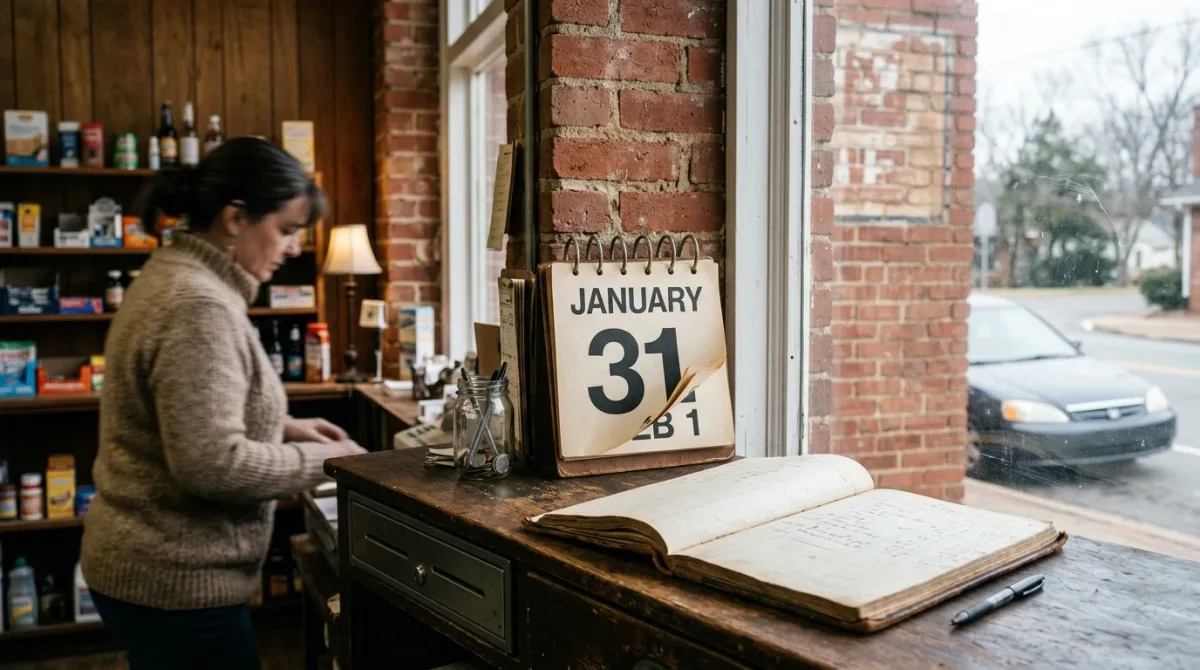
Every business operating in Union County — from a Monroe storefront to a machine shop off U.S. 74 in Indian Trail — must report its equipment, furniture and other taxable property to the county by Jan. 31 each year, or face an automatic 10% penalty, according to Union County's Tax Administrator's office.
The requirement is not new, but it catches new business owners every winter. North Carolina sets a statewide listing period each January, and Union County enforces it the same way every other county in the state does: a form, a deadline, and a penalty for the late.
What counts as taxable business property?
Union County's Tax Administrator's office says businesses must report machinery, equipment, computers, office furniture, fixtures, supplies, airplanes, farm machinery and any other "income-producing personal property" used in the business. This category is separate from real estate — land and buildings are assessed on their own track — and separate from vehicle registration, which North Carolina handles through its combined tag-and-tax system rather than the annual listing period.
Statewide, the North Carolina Department of Revenue frames the underlying rule the same way Union County applies it locally: the regular listing period runs through the month of January, and tangible personal property tied to a business is listed at the business site rather than the owner's home address, which is the default rule for most other personal property in the state.
For a retailer in Waxhaw or a contractor based in Marshville, that means the desks, registers, shop tools and shelving inside the business location — not the owner's house — are what gets reported, regardless of where the business owner personally lives.
How does a business actually file?
Union County mails listing forms each year to businesses that filed the previous year, sent to the address the county has on record. A business that does not receive a form — commonly a new business, or one that moved locations within the county — has to contact the Tax Administrator's office directly to get the correct paperwork rather than assume that no form means no obligation.
- Confirm whether the county has your business on file; new businesses and recently moved ones should call rather than wait for a form.
- Use the 2026 Personal Property Listing Form, available through the county's online listing portal, or the mailed paper form.
- Report machinery, equipment, computers, furniture, fixtures, supplies and any other income-producing personal property at its business-site location.
- Submit by Jan. 31, or file a written extension request postmarked by that date if more time is needed.
The county also offers an online filing option through its listing portal, alongside online extension requests. Paper forms and instructions covering machinery, equipment and farm property specifically are posted on the county's tax department pages as well, for businesses that prefer not to file digitally.
What happens after Jan. 31?
Listing forms not received by the deadline are subject to a 10% penalty, per the Tax Administrator's office — an automatic add-on to whatever tax bill follows, not a discretionary fine a business can appeal on the merits of being new or unaware. The county does allow extensions, but only on written request, and only if that request is postmarked by Jan. 31 itself; a business cannot ask for more time after the deadline has already passed.
North Carolina law gives county commissioners some flexibility on the front end of the calendar. Boards can extend the regular listing period itself by up to 30 days in a normal year, or up to 60 days in a reappraisal year, and individual businesses can separately request an extension to April 15 during the regular listing period. But once Jan. 31 passes without either a filed form or an approved extension request already in hand, the 10% penalty applies to that year's listing.
Why the county cares about the business tax base
The listing process feeds directly into what the county can raise from commercial property, at a moment when Union County is actively trying to grow that base rather than simply collect from what already exists. The Board of Commissioners' adopted budget for fiscal year 2026-2027, announced June 17, 2026, set the county property tax rate at 43.42 cents per $100 of valuation — unchanged from the prior year — inside a $664.3 million operating budget.
Of that rate, county officials said roughly 71% funds education between operating and debt service, while 12.75 cents supports core county services such as public safety. The same budget set aside $556,000 for land acquisition intended to help recruit new industries and expand the commercial tax base, according to the county's announcement — a signal that accurate business-property listings matter to county finances beyond any single company's own tax bill.
| Fund | Rate (cents per $100 valuation) |
|---|---|
| General fund | 11.24 |
| Debt fund | 1.06 |
| Education operating fund | 26.78 |
| Education debt fund | 3.89 |
| Economic development | 0.45 |
That combined rate applies to real and business personal property alike, once a business's listed equipment and fixtures are valued and added to the county's tax base for the year. A business that under-lists its equipment, or misses the deadline entirely, is not just risking a penalty on its own bill — it is a gap in the base the county is trying to expand through its own land-acquisition and industry-recruitment spending.
The rule does not distinguish between a large employer and a one-person operation. A home-based bookkeeper in Wingate with a laptop and a filing cabinet used for the business, and a freight operator in Weddington with a fleet of loading equipment, are both covered by the same "income-producing personal property" standard described by the Tax Administrator's office — the size of the listing differs, but the Jan. 31 obligation does not.
Where to get the correct form
Businesses without a prior-year listing, or those unsure which form applies to their equipment, can reach the Union County Tax Administrator's office at 704-283-3746 or [email protected], or visit the office at 500 North Main Street in Monroe, the county seat. The state's own listing-requirements guidance, maintained by the North Carolina Department of Revenue, covers how the same basic rules apply outside Union County for businesses that operate locations in more than one North Carolina county.
For a related community perspective, read How to speak at a Union County meeting, step by step.
For more context, read Union County to charge $2,000 minimum for water plan reviews.
For more context, read How to build an emergency fund on a tight budget.
For more context, read How DJs Get Paid: The Fee Economy Explained.