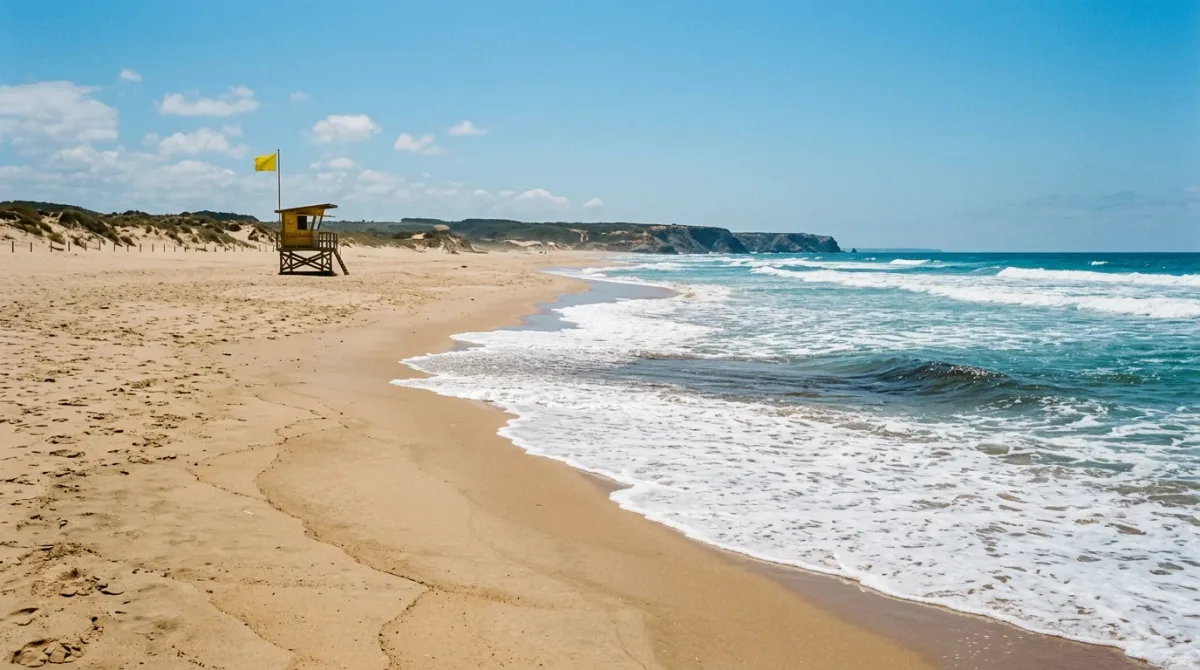
The safest response to a rip current is to stay calm and swim parallel to the shore until clear of the pull, then angle back toward the beach — guidance the National Weather Service (NWS) and NOAA's National Ocean Service repeat often, because rip currents are tied to more than 100 U.S. beach drownings a year, an estimate from the United States Lifesaving Association that the NWS cites on its official rip current safety page.
They are also easy to misjudge, because a rip current needs neither a storm nor rough surf to form. "Rip currents often form on calm, sunny days," the NWS notes on its official rip current safety page, which is exactly why the agency treats spotting one — and knowing the escape drill — as a core piece of beach planning, not just storm-season advice.
What Does a Rip Current Look Like From the Sand?
NOAA's National Ocean Service describes rip currents as "powerful, channeled currents of water flowing away from shore," and the clearest way to catch one before wading in is to scan the surf line from a fixed spot on the sand, not from the water. Look for a narrow gap of darker, calmer-looking water sitting between two areas of breaking waves — a break in the normal wave pattern is often the first sign, according to the agency. Other tells include a visible difference in water color, and foam, seaweed, or debris moving steadily out to sea rather than washing in with the waves.
The National Weather Service's Wilmington, North Carolina forecast office, which covers a stretch of the Carolina coast, adds that the same signs — churning, choppy water; a stripe of turbulent whitewater extending seaward past the breakers — hold across most surf beaches, though currents can also form near structures like jetties and piers where water finds an easy path back to open ocean.
Why Do They Form Even on Calm, Sunny Days?
According to the NWS, rip currents develop when incoming waves push water up the slope of the beach faster than it can drain away evenly. That excess water finds the path of least resistance — often a gap in a sandbar, or the edge of a jetty or pier — and rushes back out to sea in a narrow, fast-moving channel. Because that mechanism depends on wave and seafloor shape rather than storm intensity, a rip current can form under bright skies and small waves just as readily as during rough weather, which is the myth the agencies most want beachgoers to drop.
What Should You Do if You're Caught in a Rip Current?
Both NOAA's National Ocean Service and the NWS give the same core instruction: stay calm, and never try to swim directly against the current back to shore — it's a fight most swimmers, even strong ones, will lose to exhaustion. Instead, swim parallel to the beach until free of the current's pull, then angle back toward land once clear. If swimming out of it isn't possible, float or tread water and signal for help by facing the shore and waving your arms.
A useful clarification, reported by travel outlet Frommer's citing NOAA data: rip currents do not pull swimmers underwater. The danger comes from being carried away from shore, which can trigger panic and exhaustion rather than a struggle against being submerged. Frommer's also notes that rip currents can move faster than 5 miles per hour — quicker than Olympic swimmer Michael Phelps' recorded top speed of 5.5 mph in short bursts — which is part of why fighting one head-on rarely works.
What Do NWS Risk Levels and Beach Flags Mean?
Local NWS forecast offices, including the Wilmington and Charleston offices that cover the Carolinas, issue a daily rip current risk rating as part of the surf zone forecast: low risk means life-threatening currents are possible but less likely; moderate risk means they are possible; high risk means they are likely and considered dangerous for all swimmers, not just weak ones. Beaches often pair that forecast with a flag system posted at lifeguard stands — commonly green for calm conditions, yellow for moderate risk, red for high risk, and double red for water closed to swimming — though Frommer's cautions that flag colors and their exact meaning can vary by beach, town, or state, so it's worth confirming the local system before reading the flags on any new stretch of sand.
| NWS Risk Level | What It Means | What to Do |
|---|---|---|
| Low | Life-threatening rip currents possible, but less likely | Swim near a lifeguard; still check conditions before entering |
| Moderate | Life-threatening rip currents are possible | Extra caution; heed lifeguard instructions and posted flags |
| High | Life-threatening rip currents are likely; dangerous for all swimmers | Consider staying out of the water; follow all local closures |
The NWS Wilmington office's review of two decades of Carolina coast data — 196 rip current drownings across North and South Carolina between 2000 and 2025, or roughly eight a year — found that 86% of those who died were male, and half were visitors from out of state, a pattern the office attributes partly to unfamiliarity with a specific beach's sandbar and current patterns. The same review found that 27% of the drownings involved a bystander who entered the water attempting a rescue, which is why both agencies emphasize signaling a lifeguard or calling 911 rather than swimming out after someone in trouble.
Practical Details
- Who issues the forecast: Your local National Weather Service forecast office, as part of the daily surf zone or beach forecast
- Cost: Free to check, at weather.gov's beach and marine forecast pages
- Best safety rule: Swim only at a lifeguard-protected beach, per NOAA's National Ocean Service
- 2026 awareness date: National Rip Current Awareness Week runs April 26–May 2, 2026, per NWS Wilmington and Charleston
- Before you go: Conditions change — check the official rip current outlook and posted flags before entering the water
Frequently Asked Questions
Do rip currents pull swimmers underwater?
No. NOAA's National Ocean Service and Frommer's, citing NOAA data, both note that rip currents carry swimmers away from shore rather than under the surface. The real risk is exhaustion or panic from being pulled out, not submersion, which is why staying calm is the first step agencies recommend.
Can a rip current form on a calm, sunny day?
Yes. The National Weather Service states that rip currents "often form on calm, sunny days," since their formation depends on wave and seafloor shape rather than storm conditions. Good weather is not a reliable signal that swimming conditions are safe.
What does a red or double-red beach flag mean?
Per Frommer's, red generally signals high-risk conditions and double red typically means the water is closed to swimming, though exact flag meanings can vary by beach or state, so it's worth confirming the local system at the lifeguard stand.
How fast can a rip current move?
Frommer's, citing NOAA figures, reports rip currents can exceed 5 miles per hour — faster than Olympic swimmer Michael Phelps' recorded top speed of 5.5 mph in short bursts — which is why swimming directly against one is rarely effective.
When is National Rip Current Awareness Week in 2026?
NWS forecast offices including Wilmington, North Carolina and Charleston, South Carolina, list National Rip Current Awareness Week as April 26–May 2, 2026, timed to the start of the beach season along the Carolina coast.
For a related travel news perspective, read Ben Affleck and Matt Damon Make a Splash on Gossip Stone TV.
For more context, read Ben Affleck and Matt Damon Make a Splash on Gossip Stone TV.