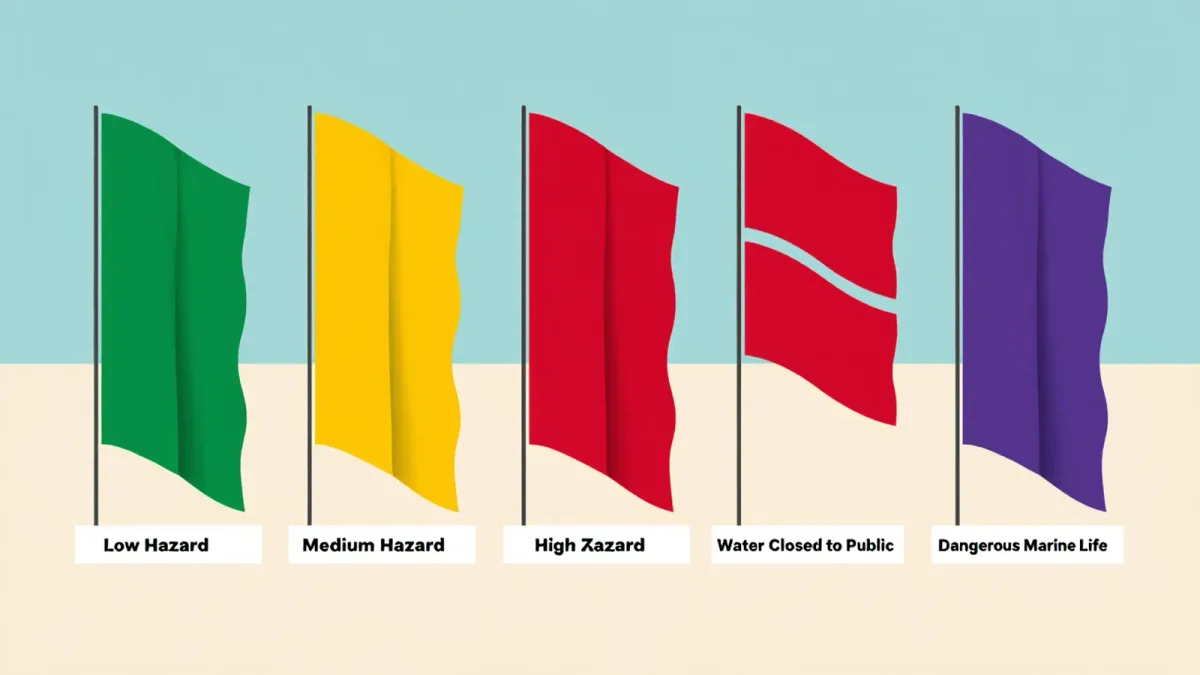
Beach warning flags are the fastest weather report on any guarded beach: green signals calm conditions, yellow signals moderate hazard and caution, red — one or two — signals high hazard with swimming discouraged or closed, and purple signals dangerous marine life in the water, not dangerous water. The color scheme is used by lifeguard agencies across the US coastal states, and the International Life Saving Federation promotes a similar system worldwide, but adoption is local: each town, county, or park authority decides whether it flies flags at all, and exactly what it posts. That is why the sign at the lifeguard stand — the legend — outranks any chart, including this one.
This guide explains the system as a traveler's skill. Flag postings are decisions of the on-duty lifeguard service based on current, dated observations; they change during the day, and they are not a guarantee in either direction.
Where does the flag system come from?
There is no single federal law requiring beach flags in the United States. The widely used color set traces to the standard adopted by the United States Lifesaving Association and promoted through the International Life Saving Federation's rescue and water-safety standards, and it has been written into ordinances and park rules beach by beach — Florida statutes require flag displays at public beaches entering the Gulf and Atlantic, per the Florida Department of Environmental Protection's beach flag program, while many other states post flags as a lifeguard-service practice rather than a legal requirement. The practical consequence: the system is consistent enough to learn once, but the legend sign at your beach is the authority.
The colors, one by one
- Green: calm conditions; swimming permitted. Green never means supervision-free — it means the water measured calm when posted.
- Yellow: moderate surf or currents; caution. Weak swimmers and children should stay shallow and near an occupied tower.
- Red (single): high hazard — rough conditions; swimming discouraged. Strong swimmers only, and near a tower.
- Double red: water closed to the public per the posting authority. Entering the water under double red is prohibited on beaches that fly it, and can carry a fine.
- Purple: dangerous marine life — jellyfish, stingrays, and similar hazards present. Purple is the flag most out-of-state visitors cannot name, and it can fly alongside any color: a purple-over-yellow day is common in jellyfish season on the Gulf.
- Orange or red-and-white: depending on the authority's legend, an interrupted area, emergency, or aircraft/boat warning. Read the posted legend; meanings here vary the most.
The purple flag deserves its own briefing
Purple is condition-specific in a way the other colors are not: it tells you what is in the water, not how the water moves. Gulf beaches in Florida and Alabama fly purple through much of the warm season as jellyfish and stingray activity rises, per local lifeguard services' posted protocols. Two practical notes travelers use: shuffle your feet in shallow water — the standard stingray-avoidance guidance taught by lifeguard services — and keep vinegar or the lifeguard station in mind, not fresh water, for jellyfish stings per first-aid guidance from medical sources. The flag exists so you adjust behavior without leaving the beach.
How flags relate to the weather forecast
Flags are observations; forecasts are predictions, and they come from different offices. The National Weather Service issues Surf Zone Forecasts and coastal hazard statements that lifeguard services use to set the morning flag — but the flag updates through the day as conditions change, which the forecast cannot. The traveler's sequence: check the NWS surf zone forecast the night before, check the beach authority's flag status page or app in the morning, and read the physical flag at the tower when you arrive. When the three disagree, the physical flag wins.
Flags are local: the three-system reality
Travelers crossing state lines meet three overlaps. Florida mandates the color system at public beaches by statute, per the state's beach flag program. Hawaii posts a different-looking but compatible sign-based hazard system at many beaches, per state county lifeguard services, with signs rather than colored cloth doing more of the work. And some Northeast and West Coast towns fly no flags at all, relying on signage and lifeguard whistles. The skill that transfers is not memorizing colors; it is the habit — walk to the nearest tower or posted legend, read what today's flags mean here, then swim near the guards.
How does a lifeguard service set the morning flag?
The posting is a chain of dated observations. The service starts from the National Weather Service surf zone forecast and any active coastal hazard statements, then adds what its own crews measure at the water: wave height against the tower sightlines, observed current strength, water clarity, and reported marine-life activity from the previous day shifts. Combining those, the duty supervisor assigns the color, and towers re-assess through the day — which is why a flag can drop from yellow to green by ten, or climb to red by noon. For the traveler, the implication is useful: the flag is the freshest, most local report on the beach, compiled by people whose job it is to be right about exactly that patch of water.
A pocket routine for any guarded beach
Condense all of the above into four moves that take two minutes. One: glance at the flag before your feet touch wet sand, and again after lunch. Two: read the legend sign at the nearest tower rather than assuming last week meanings travel. Three: set up your spot within sight of an occupied tower, whatever the color. Four: ask the guard one question when you arrive — anything about today specific to that beach. Guards answer this question dozens of times a day, and the answer routinely contains a detail no forecast or website carries, such as where the sandbar shelving is gentlest or where the marine-pest activity was concentrated that morning. Travelers who run this routine at every beach they visit rarely need to think about flag charts at all; the system becomes a glance rather than a study.
What should you do when the flag changes mid-day?
Treat a change as new information, not an inconvenience. A morning yellow that flips to red means the on-duty service measured a change — rising surf, a storm cell offshore, an increase in marine-pest activity — and the correct response is to bring the group to shallower guarded water or out of it entirely, per the posted legend's instructions. Beaches with double-red closures mean out of the water, full stop; swimming under double red is prohibited and, on many beaches, ticketed, per local ordinance. If you are unsure what a flag combination means, ask the lifeguard — that is part of the job, and faster than any chart.