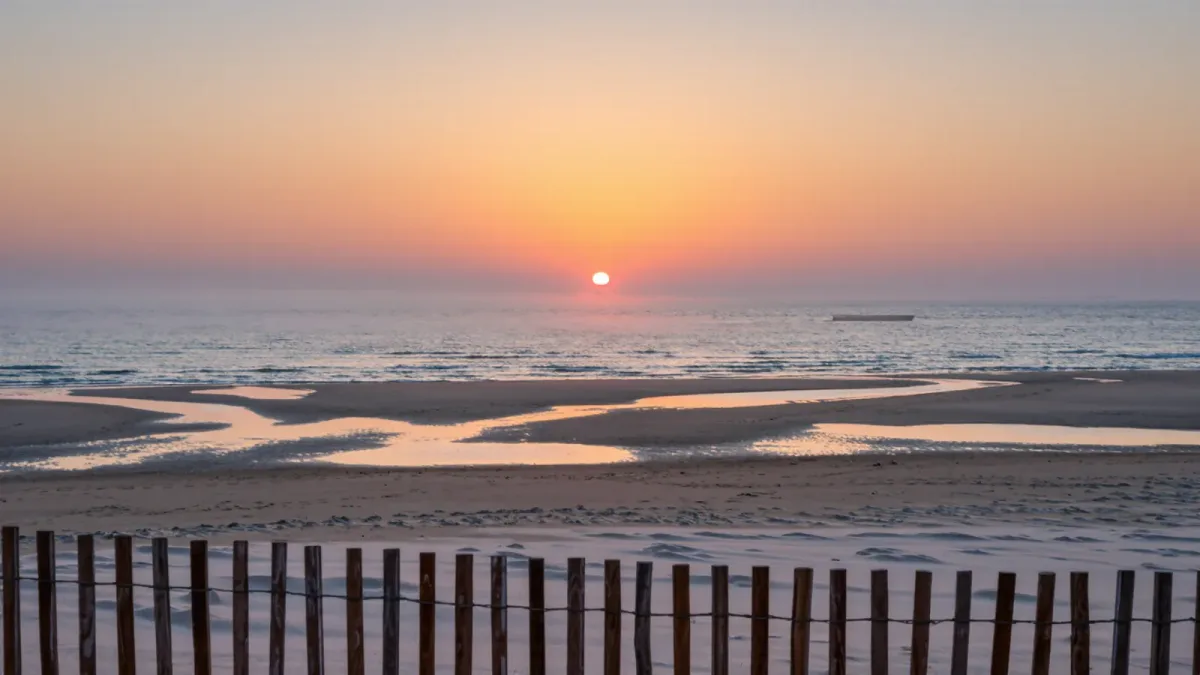
The best sunrise beaches on the East Coast share one non-negotiable: an east- or northeast-facing shoreline where the sun comes up over open water rather than behind you over land. On that test, seven standouts are Cadillac Mountain's ocean-facing slopes at Acadia National Park, and — at water level — Ogunquit in Maine, Nauset Beach in Orleans on Cape Cod, Napatree Point in Watch Hill, Rhode Island, Jones Beach on Long Island, Assateague's oceanside in Maryland, and Cocoa Beach in Florida. The sun-time math below is the practical difference: from mid-March through early November, the whole East Coast runs on daylight saving time, per the federal Uniform Time Act framework, and sunrise slips past 7 a.m. on the clock even as the sun's timing barely moves.
Sunrise times for any date and location come from the US Naval Observatory and NOAA's solar calculators — check yours for the specific date before setting an alarm. Parking gates, toll booths, and park hours are the other variable: several of these beaches open their lots before dawn, and a few do not.
Cadillac Mountain area, Acadia National Park, Maine — first light in the US
From early October through early March, Cadillac Mountain's summit sees the country's first sunrise, per the National Park Service — a function of latitude and elevation rather than myth, since in summer the earliest light reaches Mars Hill, Maine. For beach-focused travelers, the ocean-facing granite below the summit along the Park Loop Road puts the sunrise over the Atlantic; per NPS, the road and summit access operate on seasonal schedules, with the loop road closed to vehicles in winter. The reward-and-effort ratio is the point: the sun rises over water you can also walk at Sand Beach the same morning. beaches coverage.
Practical details: managed by Acadia National Park (NPS) · vehicle reservations for the Cadillac summit road run seasonally, per NPS — check current requirements · Park Loop Road vehicle access typically seasonal; winter visitors use foot trails · coldest of the picks: full winter layers in March · check NPS current road and reservation status before you go.
Ogunquit Beach, Maine — a three-mile east-facing stage
Ogunquit's long barrier beach faces almost due east, which in practice means the sun clears the Atlantic horizon with nothing in the way, then warms a walkable mile-plus of footbridge-connected sand. Per the Town of Ogunquit, the beach is town-managed with seasonal lifeguard coverage and paid summer parking — but at sunrise, lots and on-street spaces near the footbridge are free and empty from roughly October through April, the shoulder season the town's own tourism calendar shows as quietest.
Practical details: managed by the Town of Ogunquit · free off-season parking near Beach Street footbridge; paid lots in summer · sunrise times per USNO tables: roughly 6:50 a.m. in late March, slipping to about 7:15 a.m. after daylight saving starts · footbridge and Marginal Way connect sunrise to breakfast in town · check the town's beach page before you go.
Nauset Beach, Orleans, Massachusetts — the Cape's classic east face
Nauset faces the open Atlantic squarely, and its morning show runs from a dune-backed lot with a snack bar that, per the Town of Orleans, operates seasonally. The beach's broad flat at low tide doubles the reflective surface of the sunrise, and the outer beach's seal population is a common early-hours sighting, per the NPS and town notices. Off-season, the town's gate is unmanned and parking is free; in summer, the paid lot opens in early morning, per town rules.
Practical details: managed by the Town of Orleans · paid summer parking, free and open off-season per town policy · sunrise over open Atlantic; low tide doubles the light · water and air are cold well into May on the outer Cape per NOAA station data · check the town's beach page for gate hours before you go.
Napatree Point, Watch Hill, Rhode Island — a conservation dawn walk
Napatree is a mile-and-a-half spit with ocean on one side, a quiet bay on the other, and a conservation easement at the end managed with the Audubon Society — per the Watch Hill Conservancy, sections close seasonally for nesting birds, so the dawn walk reads the posted signs. The sunrise faces southeast-east over Fishers Island Sound, and the spit's curvature gives photographers a water horizon plus historic Watch Hill cottages catching the first light behind.
Practical details: managed by the Watch Hill Fire District with conservation partners · seasonal bird-nesting closures at the point, per posted signs · village street parking has posted time limits; off-season mornings are easiest · flat, easy walking; wind is the only real exposure · check the conservancy's access notices before you go.
Jones Beach, Long Island, New York — the sunrise with infrastructure
Jones Beach faces south-southeast, and its six miles of ocean beach catch the sunrise over open water with an unusual luxury for 5:45 a.m.: restrooms and field lots that, per the New York State Office of Parks, Recreation and Historic Preservation, open early or around the clock at certain fields, including the famous pre-dawn fishing access at Field 10. The theater's towers and the boardwalk give the light something to land on.
Practical details: managed by New York State Parks · off-season parking free; summer field fees per posted rates, and certain fields open before dawn for fishing access, per the park · boardwalk open sunrise to sunset · sunrise over open ocean at the west-facing-slanted but south-exposed ocean beach · check the park's hours page before you go.
Assateague Island oceanside, Maryland and Virginia — sunrise with wild horses
Assateague's Atlantic beach faces due east with zero development on the horizon, and the island's famous wild horses sometimes graze the dune line at first light. Per the National Park Service (Assateague Island National Seashore) and Maryland's state seashore unit, overnight and dawn beach access continues year-round, and the OSV zone lets permitted vehicles drive the sand at the Maryland end. March sunrise lands around 7:10 a.m. after daylight saving begins — a civil-alarm time, not a heroic one.
Practical details: managed by NPS (federal unit) and Maryland Park Service (state unit); rules differ by boundary · entrance fees per posted rates at each unit · OSV permit required for driving the sand, per NPS · horses are wild: keep posted distance, never feed · check NPS and state park pages for current access before you go.
Cocoa Beach, Florida — the warm-water sunrise
Florida's east-facing Atlantic coast is the country's only place where sunrise-over-the-ocean comes with 70s-degree air for much of the year. Cocoa Beach's pier gives the rising sun a focal point, and per the City of Cocoa Beach, parking is free at many A1A access points, with the beach open around the clock. On launch mornings, per NASA and SpaceX published schedules, a rocket rising on the same horizon is a plausible bonus — check the posted launch calendar.
Practical details: managed by the City of Cocoa Beach · free parking at most A1A crossovers, per the city · year-round season; March air averages in the low-to-mid 70s °F per NOAA climate normals · rocket-launch mornings add traffic: plan around posted schedules · check the city's beach page before you go.
What time does the sun rise on the East Coast?
The spread is enormous, and it is the real planning variable. From Maine to Florida, the same calendar date differs by roughly an hour: solar physics puts Portland, Maine about 50-60 minutes ahead of Miami year-round, per USNO solar tables. Add the daylight saving shift — spring forward moves sunrise from about 6:20 a.m. to 7:20 a.m. on the clock overnight in mid-March, per the Uniform Time Act schedule — and the practical rule for travelers is simple: look up USNO or NOAA sunrise tables for your exact beach and date, then arrive 20 minutes early. The best color runs before the sun itself appears.
How do you plan a sunrise beach morning?
Do the math backward: sunrise time, minus 20 minutes for color and parking, minus your drive. Check three things the night before — the lot's opening status with the managing authority, the NWS coastal forecast for cloud cover (thick marine stratum kills the show), and the tide table, since low tide widens the reflective wet sand that makes the photographs. Bring a layer rated ten degrees colder than the forecast: ocean-front dawn runs cooler than town, everywhere on this list.