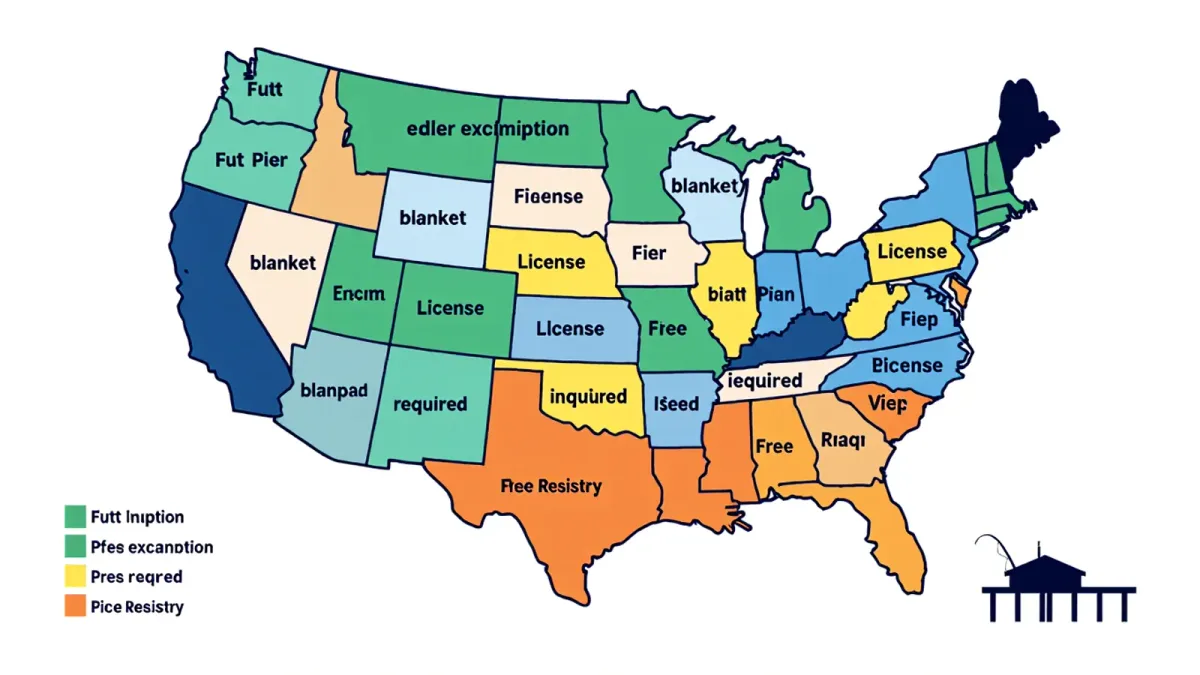
In several of the country's best pier-fishing states, the answer is no: California waives the sportfishing license entirely for anyone fishing from a public ocean pier, per the California Department of Fish and Wildlife, and Texas waives license requirements for fishing from the bank or a pier inside Texas state parks, per Texas Parks and Wildlife. In most other coastal states you will need a license of your own — or you will be standing on a pier that holds a blanket license covering everyone on it. The rules differ enough state by state that a two-minute check before you go — the state agency's licensing page, then the pier operator's own sign — settles the question. This guide walks through the four mechanisms you will encounter and where each applies; fees, age thresholds, and free-fishing days change often, so treat every figure as a pointer to the managing authority rather than a quote.
One framing note keeps the rest of this simple: pier fishing is regulated as saltwater fishing in tidal waters, and the licenses involved are state recreational licenses — not the federal permits commercial boats carry. Since 2011, state licenses have also satisfied the federal Saltwater Reel-to-Reel registration requirement through national standards implemented by NOAA Fisheries, so an angler covered by a state license or exemption generally does not register separately. Where a state runs no license system at all for saltwater, that state typically operates a free registry instead — which is its own small chore.
Which states waive the license on public piers?
California is the cleanest case: the California Department of Fish and Wildlife states that no fishing license is required when fishing from a public pier in ocean waters, and the department publishes its own list of qualifying piers — from the Berkeley Pier to Ocean Beach Pier in San Diego. The exemption covers the pier structure itself; step off onto a beach, jetty, or private dock, and the license requirement returns. Texas runs a different waiver with the same effect: anglers fishing from the shore or a pier within a Texas state park do not need a fishing license, per Texas Parks and Wildlife, which is why park piers along the Gulf — Mustang Island, Sea Rim — draw license-free crowds. Both waivers can be suspended on designated free-fishing-day reversals or regulation changes, so confirm on the agency site in the week you fish.
What is a blanket pier license, and which states use it?
Several Southeastern states let a pier itself buy the license. The pier operator pays an annual blanket fee, and every patron fishing from that structure is covered — no personal license required, though a pier admission fee often replaces it. North Carolina's coastal recreational fishing license system includes blanket coverage for licensed ocean piers, and the state's Division of Marine Fisheries maintains the list; in practice this is why fishing the piers at Nags Head or Kure Beach usually means paying the pier's entry fee and nothing more. Florida works on a similar principle: the Florida Fish and Wildlife Conservation Commission sells annual pier licenses to pier operators, and anglers fishing from a licensed pier are exempt from the individual saltwater license — but not every structure buys one, and shore-adjacent sections can be treated differently, so the pier's own posted policy is the deciding document. South Carolina runs an equivalent arrangement for its licensed public fishing piers, including the state-park piers at Myrtle Beach and Hunting Island.
Where do you still need your own license to fish from a pier?
Gulf and South Atlantic states without a full pier exemption expect most pier anglers to carry one. In Alabama, a saltwater license is generally required unless you are on a qualifying public pier whose license covers you; in Mississippi and Louisiana, state saltwater licenses apply to pier fishing with defined exemptions; in Georgia, a saltwater license is required except on designated free-fishing days. On the Atlantic, New Jersey requires no saltwater license but does require free enrollment in the New Jersey Saltwater Recreational Registry Program, per the state's division of fish and wildlife, while neighboring New York requires a free marine fishing registration. In Maine, no saltwater fishing license exists at all — the state regulates through size, season, and bag limits instead. The pattern to remember: the states that charge almost always offer an online license good for a day or a year, issued in minutes on the agency site or its official app.
Who is exempt everywhere, and what about free fishing days?
Three exemptions recur across state lines. Age thresholds exempt the youngest and often the oldest anglers — the exact ages vary by state, commonly somewhere in the mid-teens and, in some states, past retirement age. Resident shoreline or pier provisions in a handful of states — Florida's free resident shoreline license is the best-known example — reduce the cost to zero for fishing from land for state residents. And nearly every licensed state designates license-free fishing days, typically clustered in early summer, when anyone may fish without buying a license; bag and size limits still apply on those days. Active-duty military on leave, anglers fishing on licensed for-hire trips, and visitors at licensed obligations each have their own clauses — the agency page, not this article, is the authority.
How do you actually get a license before a pier trip?
Buy online, screenshot the confirmation, and carry it offline: cell coverage fades exactly where the fish are. Most state agencies issue licenses through their own portals or apps in minutes, with one-day, multi-day, and annual options for residents and non-residents. Check three things at the same time: whether the specific pier is covered by a blanket license (the pier operator's site or posted rules), which free-fishing days fall in your travel window, and the current bag and size limits for the species in season — limits are enforced from the pier as strictly as from a boat. If a rule on the pier's sign and the state site disagree, ask the pier operator in writing or call the regional office of the state agency before you fish. Rules and fees change — check the official licensing page for your state before you go.
| State | Pier-fishing rule (general shape) | Where to confirm |
|---|---|---|
| California | No license from a public ocean pier; required off the structure | CA Dept. of Fish and Wildlife pier list |
| Texas | No license fishing from shore or pier in state parks | Texas Parks and Wildlife |
| Florida | Individual license required except on piers holding an annual pier license; free resident shoreline license | FWC licensing pages, pier operator |
| North Carolina | Coastal license required; licensed ocean piers' blanket coverage applies | NC Division of Marine Fisheries |
| South Carolina | Saltwater license required except on licensed public piers | SC Dept. of Natural Resources |
| New Jersey | No saltwater license; free state registry required | NJ Saltwater Recreational Registry |
| Maine | No saltwater license; size, season, and bag limits apply | Maine Dept. of Marine Resources |