Beach cooler food safety comes down to one number pair: perishable food needs to stay at or below 40 degrees Fahrenheit, and it enters the danger zone above that line, per the USDA Food Safety and Inspection Service's guidance — which on a 90-degree July beach gives sealed perishables roughly one hour before they should return to the ice, and half that when the air passes 90. The cooler that meets the standard is built, not bought: a full cooler with plenty of ice holds longer than a half-full premium model, a separate drinks cooler is opened hourly while the food cooler stays shut, and the freezer-blanket layer on top buys the afternoon. The menu decides the rest — some foods are engineered for the beach, and others should never leave the cooler's bottom layer.
Food-safety rules summarized here come from USDA and FDA public guidance; they are general, and individuals with specific health concerns should follow their clinicians' advice.
The temperature rules that apply on sand
Two USDA rules govern the beach cooler. First, the 40-degree floor: perishables — meat, dairy, cut fruit, cooked leftovers — belong at or below 40 degrees, which requires ice or ice packs in direct contact, not a cool box warmed by the sun. Second, the two-hour rule, halved: food left above 40 degrees is safe for up to two hours, and only one hour when ambient temperature tops 90 degrees, per FSIS guidance. On sand, the ambient is worse than the forecast — sand surface temperatures and reflected heat push the effective temperature up — so beach practice treats one hour as the limit. The exceptions with real margin: whole raw fruit, uncut vegetables, hard cheeses, bread, and sealed shelf-stable items ride safely through the day without ice, per the same guidance's definitions of non-perishables.
Ice math: how much ice a beach day actually takes
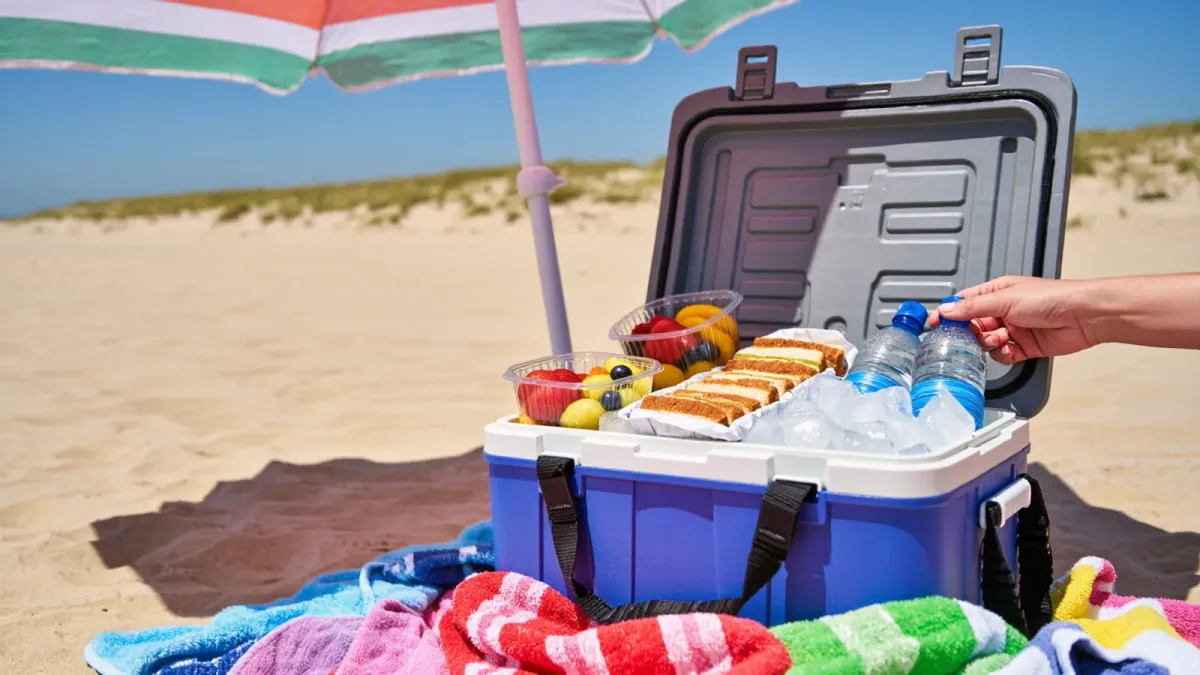
The working ratios from food-safety guidance and cooler testing: fill roughly half the cooler with ice or ice packs for a full-day outing, pre-chill the cooler indoors the night before, and pre-chill the food itself — a cooler full of room-temperature drinks melts ice on contact, per the same practices. Two-layer packing buys hours: freeze water bottles and use them as the bottom layer, since they do double duty as cold drinks as they melt, and lay a frozen towel or blanket on the top layer, where most melt-out happens. Block ice outlasts cubes roughly two to one, per common cooler-testing comparisons, so the full-day cooler carries a block base with cube fill. And the quiet multiplier: a full cooler, whatever fills the space — ice, food, frozen bottles — holds temperature far longer than a half-empty one.
Two coolers, one rule: drinks float, food sinks
The single highest-value cooler habit is separation. Drinks get opened every twenty minutes, and every opening exchanges the cold air for hot; a dedicated drinks cooler absorbs that traffic so the food cooler keeps its seal, per the same FSIS cooler practices. The food cooler then earns its keep by discipline: packed in reverse-use order — dinner at the bottom, lunch mid-level, snacks at the top — stored in the fullest shade available, on the cool side of the umbrella's arc, lid latched, and buried under a towel. Sand works as an insulator only if the cooler is lidded and the lid stays out of it; a half-buried open cooler is a sandstorm with condiments.
What packs and what stays home
- Survives all day, no ice: whole apples, oranges, uncut melon, carrots, cherry tomatoes, bread and rolls, hard cheeses, nut butter, sealed jerky and shelf-stable pouches, per USDA definitions of non-perishable picnic foods.
- Safe with ice discipline (bottom layer, tight wrap): deli sandwiches with mustard rather than mayo-heavy fillings, cut fruit in sealed containers, yogurt pouches, cooked chicken — all must return below 40 within the one-hour window.
- Never worth the risk on a hot beach: raw-meat marinades traveling with ready food, soft cheeses and cut dairy sitting out, sushi, cream-based salads, and anything already cooked and reheated once, per the FSIS handling guidance.
- The grilling case: raw meat travels frozen or on ice in its own sealed bin below ready-to-eat food, a separate plate carries cooked items off the grill, and a thermometer — not color — confirms doneness, per the FSIS grilling guidance; 165 degrees for poultry, 160 for ground meats.
Signs, doubts, and the one-hour test
Food-safety guidance is blunt about the endpoint: if perishable food has sat above 40 degrees beyond its window — one hour over 90 degrees — discard it; smell and appearance do not detect the bacteria that matter, per FSIS consumer guidance. The beach version is a clock, not a test: note when the ice melted through or the cooler sat open in the sun, and treat that timestamp as the shelf life of everything perishable inside. Cooler thermometers, a few dollars, settle the question for households that beach often — the interior of a well-packed cooler can hold below 40 for six or more hours on a hot day, per cooler-testing patterns, but only measurement turns that claim into knowledge for your specific cooler.
Does a soft cooler or hard cooler hold up better at the beach?
Hard-sided coolers insulate better and take sand abuse, which is why they anchor the all-day beach setup; soft-sided coolers win for the two-to-four-hour trip — lighter, packable, and honest about their limits, per the insulation comparisons in consumer testing. The combination that beach regulars land on: a hard cooler as the base camp that never leaves the shade, plus a small soft cooler for the waterline errands. Whichever you carry, the variables that matter are the same: pre-chill, pack full, ice in contact, lid closed — the cooler's quality decides the price of doing those things, not whether they work.