Beach accessibility in the US rests on two practical tools: rolled access mats that cross the soft sand to the dry beach, and floating beach wheelchairs — loaned free at most equipped beaches — that go where mats end. Federal law guarantees the program behind them: Title II of the Americans with Disabilities Act requires state and local government programs, which includes public beaches, to be accessible when readily achievable, per the Justice Department's ADA guidance, and the Access Board's outdoor-developed-areas standards spell out what that means on sand. The result is uneven but findable: hundreds of US beaches now post mats, ramps, and wheelchair loan programs, and a traveler who knows what to ask for can book an accessible beach day at most major coastal destinations.
This guide explains what exists, who provides it, and how to confirm it for your dates. Facilities change seasonally — mats go down in summer, loaner fleets run on reservations — so the managing authority's page for your specific dates is always the deciding source.
What does the ADA actually require at a beach?
The ADA does not require every beach to be paved to the water, and it helps to know what the law realistically asks. Title II covers programs of public entities: a public beach must offer its program — the beach experience — through accessible means where readily achievable, per DOJ ADA guidance. The Access Board's accessibility standards for outdoor developed areas, applied to federal and adopted by many state systems, specify accessible routes to reach beach access points, and note where removable surfaces such as mats can serve. What that means on the sand: an accessible route from an accessible parking space to the upper beach is the core requirement at most managed beaches, and everything beyond — mats, chairs, ramps to the waterline — is the layer a well-run beach adds voluntarily. State parks publish beach accessibility inventories; the federal units follow the Access Board's standards.
Access mats: how they work and what they reach
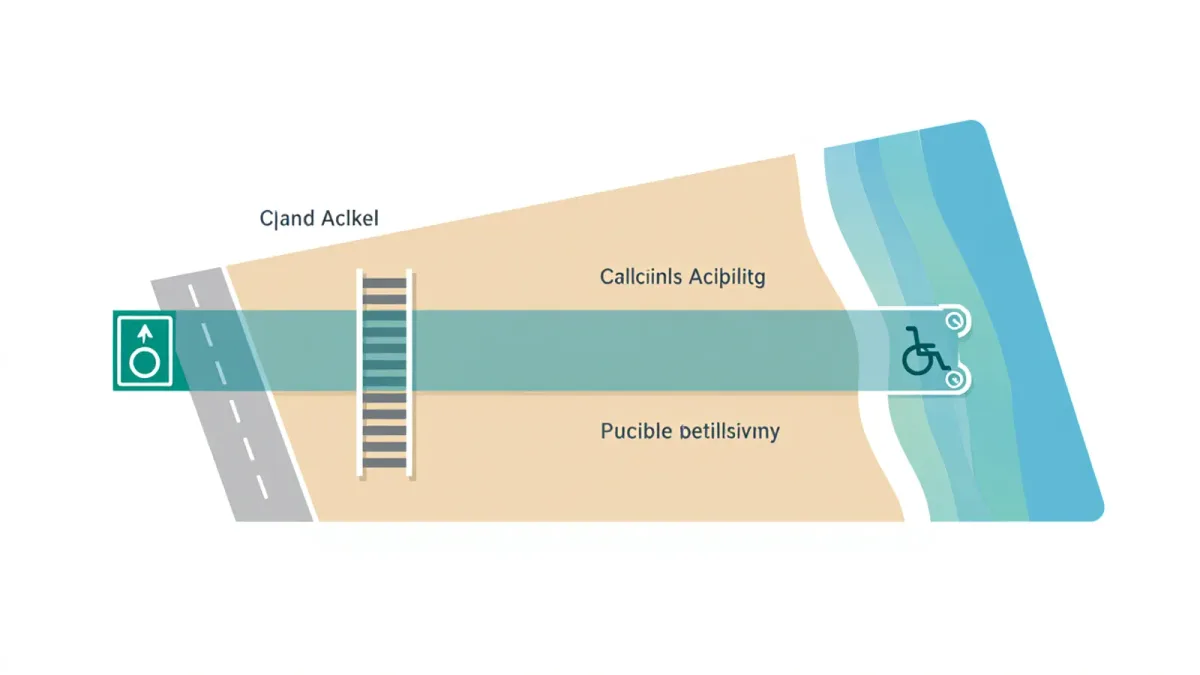
A beach access mat is a roll-out surface — typically high-density plastic panels or connected rolls — anchored at the top of the beach and unrolled across the sand toward the waterline, per manufacturer and park-system descriptions. Standards of practice: mats support standard wheelchairs, walkers, and strollers; they are firm and stable when taut, and they end wherever the authority has laid them, commonly at the dry-sand line. Their limits matter for planning: a mat is not itself a route to the water if it stops at dry sand, and soft sand beyond the mat is the same barrier it always was. Beaches that pair a mat with loaner chairs close the gap; beaches that only roll a mat are the more common case.
Beach wheelchairs: the loaner fleet model
The standard solution to soft sand is the floating beach wheelchair: large balloon tires or a PVC-and-buoyancy frame that rolls over sand and floats in shallow water. Across the US, the dominant model is free short-term loan from the managing authority — state parks, county beach divisions, and national seashores maintain fleets and lend by reservation or first-come, per their posted programs. The rules that vary and deserve a phone call: reservation windows, deposit or ID requirements, escort expectations for water entry, and whether the chair goes to the waterline or into the water. Many authorities ask that a companion accompany water entry — a staffing and safety choice, not a legal limit on who may swim.
How to verify an accessible beach before you book
The verification is a five-item checklist, all answerable from the managing authority's page or a front-desk call. One: accessible parking within the posted distance of the access point, with a marked accessible route. Two: what crosses the sand — ramp, mat, or boardwalk — and where it ends. Three: beach wheelchair availability, reservation process, and hours of the loan desk. Four: the waterline itself — a mat to the water, an accessible ramp, or chair-access only. Five: the rest of the day — accessible restrooms, rinsing stations, and shade. Coastal destinations that publish all five items are the reliable bookings; the ones that answer "we have a ramp" are asking you to gamble.
Where to look: the systems that publish their inventories
Three networks make verification easy. State park systems — Florida, California, and New York among the most detailed — publish park-by-park beach accessibility pages listing mats, chairs, and reservations, per their published inventories. National seashores and park units post accessibility pages under each park's "Accessibility" tab on nps.gov, per NPS policy. And local government beach divisions — city and county — increasingly maintain accessibility pages with live mat status; a number of municipalities re-deploy mats daily and note it. Specialized directories maintained by disability-advocacy organizations aggregate the inventory across towns, though their freshness lags the authority's own page — use them to build the shortlist, then confirm at the source.
Booking an accessible beach week: practical sequence
Book in this order and the trip holds together. First, choose the beach from the authority's accessibility inventory, not the lodging's marketing. Second, reserve the beach wheelchair for your dates — fleets are finite, and peak weeks book out, per the loan programs' own notices. Third, book lodging with a verified accessible route to the chosen access point, not merely an accessible room. Fourth, confirm the waterline plan — where the mat ends, what the chair does, whether an accessible ramp exists at any nearby access. Fifth, keep the authority's phone number for the loan desk; weather and mat deployment change daily, and a morning call replaces guesswork. Travelers who run this sequence report the pattern that matters: the beach itself was never the obstacle — the information was.