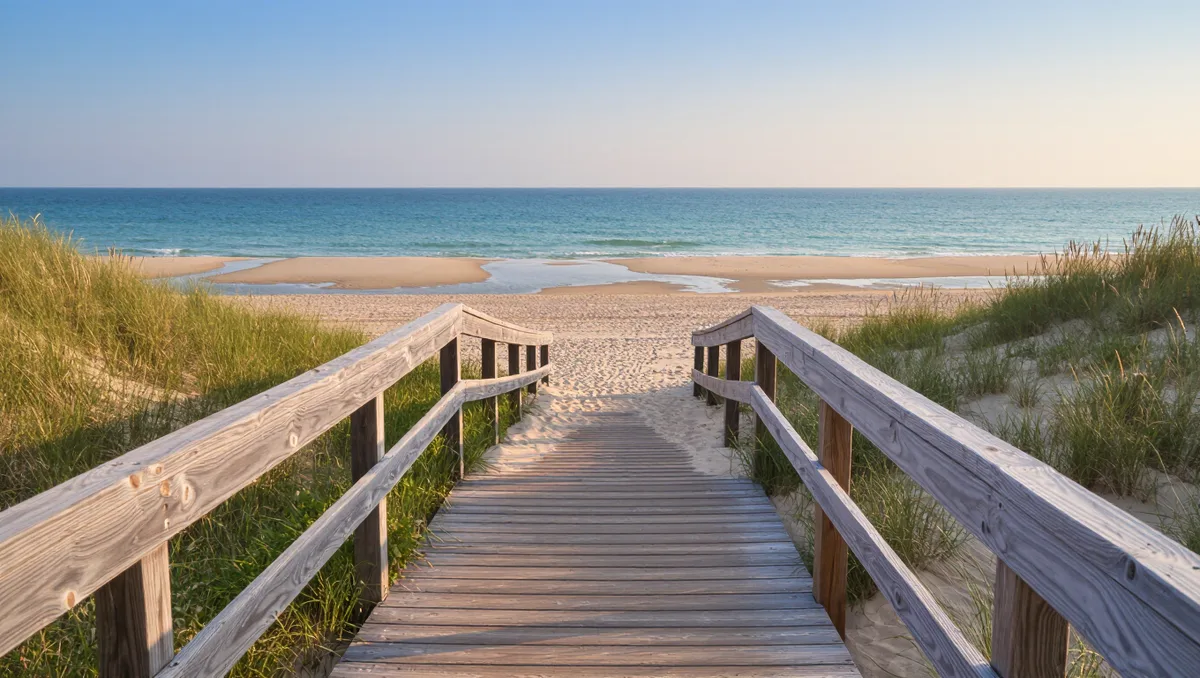
The best walkable beach towns share one test: you can park the car at check-in and never need it again until you leave. Beach, coffee, dinner, ice cream, and the hardware store for a forgotten phone charger — all on foot, all within a reasonable stroll. Very few shore communities pass, and the ones that do usually earned it by accident, from a grid of streets laid out long before anyone owned a car.
This article explains the criteria we use to judge walkability at the shore, why some beach towns look walkable but aren't, and how to verify a town's walkability yourself before you book. No ranking survives without stated criteria, so here they are up front.
What does "walkable" actually mean at the beach?
Walkability is a measure of how much of daily life you can reach on foot. At the shore, that means five things, and a town needs most of them, not just one.
- Distance to the sand. Lodging, restaurants, and shops within roughly a quarter mile of beach access put the ocean inside a five-to-ten-minute walk for most people. Beyond half a mile, heat, sand, and gear start doing the deciding for you.
- A connected street grid. Long blocks, dead ends, and loops built for cars force extra steps. Older towns with short blocks and parallel streets let you cut straight to the water.
- Real sidewalks and crossings. A sidewalk that ends at a four-lane road with no signal is not a walking route. Marked crossings matter most where the beach road separates town from the sand.
- Everyday errands on foot. A walkable shore town has groceries, a pharmacy, and a hardware store in the core — not just T-shirt shops. If dinner and a forgotten item both require driving, the town fails the test.
- Parking that works against you. Counterintuitive, but true: scarce, expensive, or metered parking near the beach is often a sign the town was built for feet. Free abundant parking usually signals a place designed around cars.
Why some beach towns look walkable but aren't
The most common trap is the resort strip. A single road lined with hotels, restaurants, and souvenir stores looks pedestrian-friendly in photos. But the strip is usually a state highway or county arterial, the beach sits across it, and everything else — groceries, breakfast beyond the hotel, the next town's attractions — requires a drive. You walk the strip once, then get back in the car.
The second trap is the gated or planned community with a beach club. The streets are quiet and shade-lined. But the town center, if there is one, is a five-minute drive away, and guests are often expected to move by car or golf cart. Quiet streets are not the same as connected ones.
The third trap is seasonal. Some towns walk beautifully in June and fall apart in August, when a road built for light traffic chokes and sidewalks fill beyond capacity. If you are planning a peak-week trip, walkability you read about in a shoulder-season review may not match what you find.
How we rank shore towns for walkability
Our analysis weighs the five criteria above, with distance to the sand and everyday errands counting the most. A town that puts you a block from the beach but a drive from breakfast scores lower than one with a slightly longer walk and a full Main Street. We also weigh shade and surface — a route through dunes and hot pavement reads differently than a shaded, boardwalked one, which is why surface choice matters enough to get its own assessment in our Sand vs Grass vs Boardwalk: What Each Beach Surface Costs Your Feet, Knees, and Cart guide. We covered a connected angle in Sand vs Grass vs Boardwalk: What Each Beach Surface Costs Your Feet, Knees, and Cart.
Because walkability depends on where you stay, not just where you visit, the same town can score differently by block. A rental two streets off the main drag can double every walk in your day. When we rank, we rank the town's core — the area a first-time visitor is most likely to book.
What this means for your booking
Practical steps, in order:
- Map it before you book. Drop the rental's address into a map and check walking times to the beach access point, a grocery store, and dinner. If any of the three exceeds fifteen minutes on foot, the listing's "walkable" claim deserves skepticism.
- Check where the parking is. If the listing includes parking, ask whether it is on-site or a lot two blocks away. If the town meters its streets, that is often a good sign for walkability — and a reason to read how Beach Parking Explained: Meters, Stickers, Apps, and Reservations — How US Beach Lots Actually Work before you arrive.
- Look at the street pattern. A grid means shortcuts. Curving loops and cul-de-sacs mean the long way around, every time.
- Consider who is walking. Families with small kids and coolers, or travelers using beach wheelchairs and access mats, have a shorter practical radius. Our Beach Accessibility in the US: Access Mats, Beach Wheelchairs, and How to Find Both guide covers how to confirm access equipment at a specific beach before you go.
How to verify walkability yourself, town by town
You do not need a ranking to judge a town. Three checks cover most of it. First, open the town's official website or chamber page and look at the map of the commercial district: is it a compact core or a strip along a highway? Second, check the managing authority's beach access page — many towns list their access points with parking notes, which tells you whether the beach is reachable on foot from the core or requires a lot. Third, read the town's own rules on seasonal parking and shuttles. A town that runs a shuttle is telling you something honest: the parts people want are too far apart to walk in high season. For related coverage, see Beach Parking Explained: Meters, Stickers, Apps, and Reservations — How US Beach Lots Actually Work.
Conditions change, and so do streetscapes — construction, renourishment projects, and new parking rules all alter a walking route. Our Beach Renourishment Projects: What They Are and How They Change Your Beach Trip guide explains one of the most common ways a familiar shore town briefly changes underfoot. Always check the town's official notices before you go.
The takeaway: walkability is a checklist, not a vibe
The evidence for calling a beach town walkable is simple and checkable: short distance to the sand, a connected grid, real sidewalks, errands on foot, and a core compact enough that the car stays parked. Towns that pass tend to be older, denser, and built before the automobile — which is why the same names keep coming up. The ones that fail are rarely dishonest about it; they just photograph well. Run the checklist on any town you are considering, and the ranking writes itself for your trip. For more beach assessments and coastal planning, start with our beaches coverage.