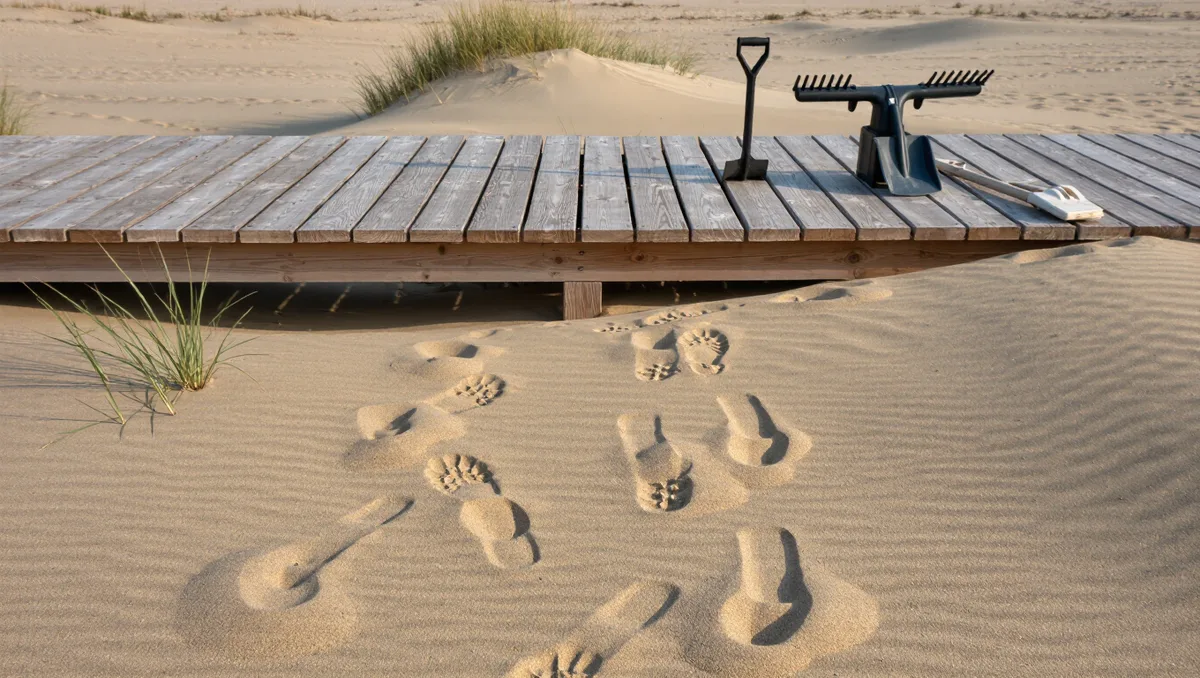
The hardest part of a beach day often happens before you see the water. It is the 300 yards between the parking lot and your spot, and the surface under that walk decides whether you arrive fresh or already tired. Soft sand is the hardest walk. Packed sand near the waterline is far easier. A boardwalk or an access mat is easiest of all.
The difference is not small. Walking on soft, dry sand means your feet sink with every step, so each stride costs more effort than the same stride on pavement. Dry sand also shifts sideways under your foot, which makes your ankles and knees do extra stabilizing work. The fix is simple: pick the route with the firmest surface for the heaviest part of your trip, and save the soft sand for the last short stretch.
This guide breaks down the four surfaces you will meet at most US beaches — soft dry sand, wet packed sand, boardwalks, and access mats — and what each one means for your feet, your knees, a stroller, or a gear cart.
Why does soft sand make walking so much harder?
Dry sand is loose by nature. Sand grains are small particles of rock and mineral, finer than gravel and coarser than silt, and on most beaches the dominant mineral is quartz, which resists weathering well. That is why beach sand holds its shape as grains but does not bind into a solid surface the way soil does. The Civil Engineering's classification of sand types notes that sand ranges from about 0.06 mm to 2 mm in grain size, and that loose, unconsolidated grains are what define it.
Loose grains mean two things for your body. First, your foot displaces sand with every step, so part of your push goes into moving sand instead of moving you. Second, the surface gives way unevenly, so the small muscles around your ankles and knees work constantly to keep you upright. That is why a walk that would take ten minutes on a sidewalk can take twenty on a dune, and why your calves burn after a short soft-sand hike.
Grain type matters too, though you rarely get to choose. Fine, rounded grains pack somewhat better than coarse, angular ones. Shell-heavy sand and coarser grains feel sharper underfoot, which matters if you are barefoot and carrying a load. What this means in practice: treat the dry-sand zone as the expensive part of the walk, and cross it with the lightest load you can manage.
Is wet sand near the water easier to walk on?
Yes, usually by a wide margin. Water fills the gaps between grains and holds them together, so wet sand forms a firm, almost pavement-like surface at the waterline. Walkers, runners, and anyone pulling a cart do best on the strip just above where the waves are actively washing in — firm enough to support weight, far enough up to avoid the surf itself.
Two cautions keep this honest. First, the firm strip moves with the tide, so a route that is easy at low tide may be underwater or soft at high tide. Check the tide timing for your beach before you plan a long walk along the waterline. Second, the wet-sand strip is where surf and currents matter, so keep an eye on the water while you walk. Our explainer on how NOAA's rip current forecast works covers what the day's risk level means before you get close to the surf. This connects to our earlier piece, How NOAA's Rip Current Forecast Actually Works, and What Low, Moderate, and High Mean.
For knees, packed sand is the kindest natural surface at the beach. It does not sink or shift, so your joints do less stabilizing work. If you are carrying a cooler or pushing a stroller, this is the surface to find.
How do boardwalks and access mats compare?
A boardwalk is the easiest surface at any beach. It is level, solid, and predictable, and it keeps wheels, canes, and tired feet off the sand entirely. The trade-offs are distance and logistics: boardwalks often run from a parking area to fixed access points, so they may not pass your exact spot, and they can be hot and crowded at midday.
Access mats and roll-out walkways solve the last-leg problem. They are laid directly over the sand from an access point toward the water, giving wheels and walkers a firm path across otherwise soft ground. Availability varies a lot by beach and season, and many towns list which accesses have them. Our guide to beach access mats and beach wheelchairs explains how to find both before you go, because a mat at one access and not the next can completely change your plan. For related coverage, see Best Shelling Beaches in the US: 6 Spots Where the Sand Keeps Giving, by Tide and Season Logic.
One more surface worth naming: grass and dune vegetation paths. Some beaches route you over a grassy strip or a dune walkover. Grass is firmer than dry sand but softer than pavement, and dune walkovers — wooden stairs and ramps over the dunes — behave like short boardwalks. Stay on the walkover or the marked path either way; cutting across dunes damages the plants that hold the dune together, and many beaches prohibit it.
What is the easiest route for a stroller or gear cart?
Wheels change the math entirely. Soft sand defeats almost every stroller and cart wheel — the narrow wheel digs in and the load stops moving. Here is the order that works:
- Boardwalk or walkover first. Any solid surface beats sand for wheels. Plan your route around where the boardwalk or dune walkover lets you out.
- Access mat second. If the beach lays mats, they take a loaded cart across sand that would otherwise be impassable.
- Wet packed sand third. Wide wheels can roll on the firm waterline strip, though salt water is hard on cheap bearings and axles, so rinse gear afterward.
- Dry sand last, and briefly. If you must cross soft sand with wheels, go straight across the shortest width, unload heavy items first, and pull rather than push — a pulled cart tracks better than a pushed one in soft ground.
Balloon-style wide beach wheels exist for exactly this problem, and some beach wheelchairs use the same idea. But the cheapest upgrade is route choice, not equipment. Two beaches with identical sand can differ hugely in effort depending on where the firm surfaces connect to the parking lot.
What does this mean for planning your beach day?
Think of surface choice as the first decision of the trip, before the umbrella or the cooler even come out of the car. A few practical steps:
- Check the access map before you park. Town and park websites usually show which lots connect to boardwalks, mats, or dune walkovers. Choosing the lot with the firm route can save you a hard carry.
- Time your arrival to the tide. A low-tide arrival widens the firm waterline strip and shortens the soft-sand crossing.
- Carry heavy gear in two lighter trips on soft sand rather than one overloaded cart, if no firm route exists.
- Wear shoes to cross, not flip-flops. Coarse or shell-rich sand is rough underfoot, and a supportive sole spares your arches on the soft stretch.
Surface also interacts with the rest of your setup. Where you plant your umbrella depends on how firm the ground is and how far you are from the firm strip, which our guide to beach shade by beach type covers in detail. And if you are still choosing the beach itself, our roundup of family beaches built around access and lifeguard data flags which spots make the walk easy in the first place. For more coverage like this, see our beaches section.
The bottom line on beach surfaces
Every beach is made of loose grains — that is what sand is — but the surfaces on top of it vary enormously. Soft dry sand costs the most effort and asks the most of your ankles and knees. Wet packed sand near the waterline is the easiest natural surface, as long as the tide cooperates. Boardwalks, dune walkovers, and access mats remove the problem entirely for wheels and tired legs.
The evidence here is mostly physics rather than field data: loose grains shift, wet grains bind, solid surfaces support. What remains unknown is exactly how much extra energy soft sand costs each person, which depends on body, load, and grain size. What the evidence does establish is the practical rule: match the heaviest part of your trip to the firmest surface available, and check which accesses offer mats or walkovers before you pick your parking spot.