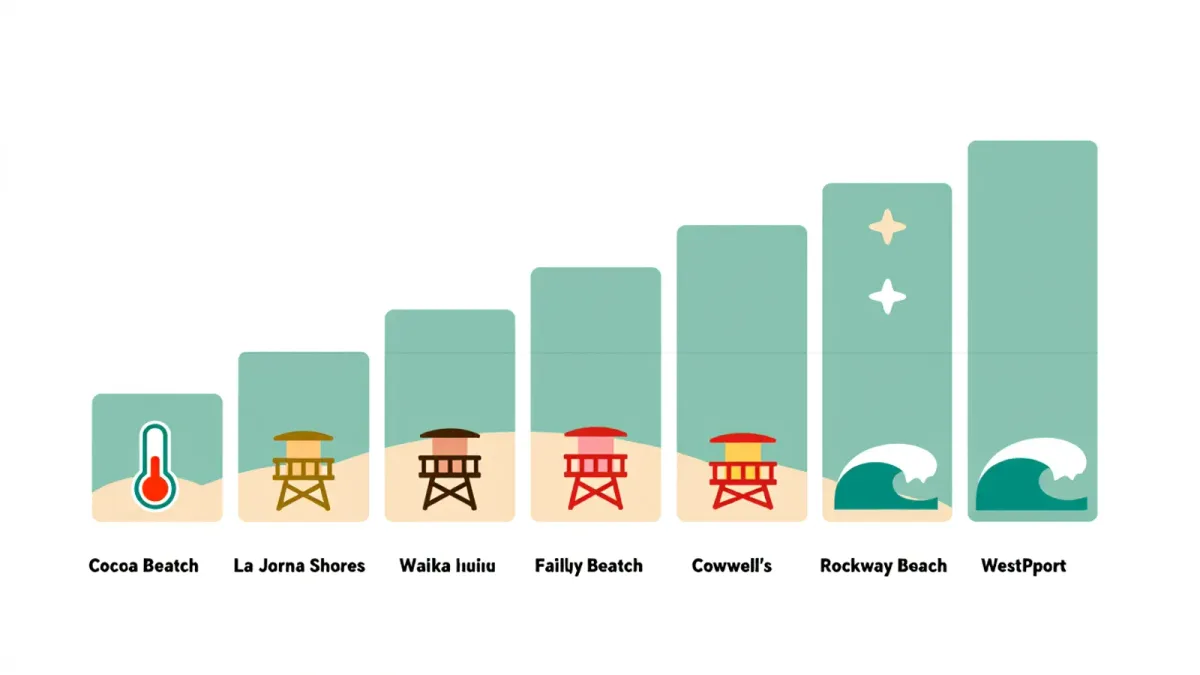
The best beginner surf beaches in the US share a short list of measurable traits: a mostly sandy bottom, slow-rolling waves with a forgiving inside section, surf schools permitted to operate on the sand, and enough space that a dozen learners in foam boards are not a hazard. On those criteria, seven standouts are Cocoa Beach in Florida, La Jolla Shores in California, Waikiki in Hawaii, Folly Beach in South Carolina, Cowell's Beach in Santa Cruz, Rockaway Beach in New York, and Westport in Washington. Skill level — not brand of board — decides safety, and every beach below is a place where first lessons are the local economy, not an afterthought.
This guide describes beaches and learning conditions; it is not surf-safety instruction. Take a first lesson with a permitted school, and always check the National Weather Service surf forecast for your beach before paddling out.
What makes a beach good for learning to surf?
Three physical traits matter more than reputation. First, a sand bottom: reef and rock punish the falls that define a first week. Second, wave shape: beginners need waves that break slowly and spill rather than pitch, in waist-to-chest-deep water. Third, scale: a long, wide beach spreads learners out, while a single peak concentrates them. Add human infrastructure — permitted lessons, board rentals within walking distance, and restrooms — and you have a beginner beach rather than merely a famous one.
Timing counts as much as geography. Almost every beach below flips from benign to punchy with a swell, so the surf report you check the night before is the real ranking.
Cocoa Beach, Florida — the East Coast's classic learning beach
Cocoa Beach built a beginner scene around long, sandy stretches south of the pier, warm water most of the year, and a dense cluster of schools and rental shops. Per the Cocoa Beach Area Chamber of Commerce and Visit Florida, the area markets itself explicitly as a learn-to-surf destination, and the spread-out sandbars produce slow, spilling waves on typical small-swell days. Summer water temperatures in the upper 70s to mid-80s °F per NOAA climate data mean a springsuit at most.
Practical details: managed by the City of Cocoa Beach and Brevard County · free and paid lots along SR A1A; the lot south of the pier fills early · year-round season; small, clean conditions most common in late summer and fall · rentals and lessons within walking distance of the pier · check the city's beach conditions page and NWS Melbourne surf forecast before you go.
La Jolla Shores, San Diego, California — the textbook inside section
La Jolla Shores is the beach California surf instructors send beginners to first, and the reasons are structural: a gradual sandy bottom that softens waves into long spilling rollers, and an explicitly designated swimming and surfing area where board traffic is predictable. Per the City of San Diego, the beach is lifeguarded year-round — one of the few in California with that coverage — which shortens the list of worries on a first day.
Practical details: managed by the City of San Diego · paid lot fills by mid-morning; street parking in La Jolla as backup · lifeguarded year-round per the city · busiest summer weekends; weekday mornings quietest · lessons and rentals at the north end · check the city lifeguard division page and NWS San Diego surf forecast.
Waikiki, Oahu, Hawaii — the slowest ride in America
Waikiki's long, rolling breaks — Canoes, Queens, and the inside areas off Kuhio Beach — give first-timers rides measured in tens of seconds, not seconds, which is why more Americans catch their first wave here than anywhere else. Per the Hawaii Tourism Authority and the City and County of Honolulu, the beach is managed with lifeguard towers along its length, and outrigger-canoe and board lessons operate under city permitting. The trade-off is company: the inside is busy, so lessons matter for right-of-way as much as technique.
Practical details: managed by the City and County of Honolulu · lifeguarded during posted hours at Kuhio Beach and Queens · year-round season; summer swells push breaks further out · rentals on the sand at Kuhio Beach, lessons citywide · check the city's Ocean Safety division and NWS Honolulu forecast.
Folly Beach, South Carolina — Charleston's forgiving sandbar
Folly's wide beach and shifting sandbars produce mellow, playful waves on most small-swell days, and the walkable town behind it handles the after-session logistics: rentals a block from the sand, and a pier for the non-surfing half of the group. Per the City of Folly Beach, lifeguards staff the beach seasonally, and the county's Washout area gets the biggest surf — a section beginners should leave until later.
Practical details: managed by the City of Folly Beach (Charleston County) · paid county park lot at the pier plus town street parking · lifeguarded in season, roughly Memorial Day to Labor Day · best learning conditions on small summer and fall swells · check the city's beach rules and NWS Charleston surf forecast.
Cowell's Beach, Santa Cruz, California — the long, protected roller
Cowell's sits in the lee of the Santa Cruz wharf, which takes the edge off the swell and turns it into long, slow waves that peel forever — the reason the local surf-school industry standardized here. Per the City of Santa Cruz, the beach is part of a state-run park unit with paid lots at the wharf, and lessons run year-round in wetsuits; water in the low-to-mid 50s °F means neoprene is not optional.
Practical details: managed within Santa Cruz State coastal parks; city beaches adjacent · paid lots near the wharf · year-round with wetsuit; fall typically offers the cleanest small days · extremely crowded summer weekends; weekday mornings best · check the parks page and NWS San Francisco surf forecast.
Rockaway Beach, Queens, New York — the city beginner strip
Rockaway gives New Yorkers a subway-to-sand learning beach: protected surf areas, permitted surf schools, and seasonal rentals at several access points along a five-and-a-half-mile barrier beach. Per NYC Parks, lifeguards staff designated swim and surf areas from the day before Memorial Day through Labor Day, and surfing outside posted surf zones is restricted — the rule that keeps learners and swimmers separated. The season is short and the water is cool, but the logistics are unbeatable.
Practical details: managed by NYC Parks · surf only in designated zones while lifeguards are off or on, per posted rules · guarded season roughly late May through Labor Day · A train to the Rockaways; no car needed · wetsuit shoulder seasons, boardshorts midsummer · check the NYC Parks beach page and NWS New York surf forecast.
Westport, Washington — the cold-water graduation beach
Westport's Westhaven State Park area and the beach at the jetty are where Pacific Northwest beginners start, in full 4/3mm wetsuits, on long slow waves that the jetty partially shelters. Per Washington State Parks and the Westport-based schools that operate under permit, the area's summer low-pressure pattern delivers rideable, forgiving surf more days than not between June and September. Crowds are a fraction of California's.
Practical details: managed by Washington State Parks (Westhaven) and the Port of Grays Harbor · Discover Pass required at state park lots · wetsuit, boots, hood most of the year; water in the 50s °F · best windows late summer through early fall · check the parks page and NWS Seattle marine forecast.
When is the best time of year to learn to surf?
For the East and Gulf coasts, late summer through early fall combines the warmest water with the most frequent small, clean swells. For California, fall does the same job. For Hawaii, summer keeps the famous breaks manageable while the inside sections stay gentle. The single best week of any year is the one right after a long flat spell, when sandbars settle and the forecast shows chest-high or less — whatever the calendar says.
What should a first-timer actually book?
Book a two-hour group lesson at a school permitted on the beach you are visiting, not a private lesson on day one — watching five other people make the same mistakes is most of the education. Rent a soft-top longboard for at least two more sessions after the lesson. Budget morning slots: wind typically turns onshore by late morning, and the difference between glassy and bumpy is the difference between standing and swimming. And before any of it, read the NWS surf zone forecast for the specific beach that morning.