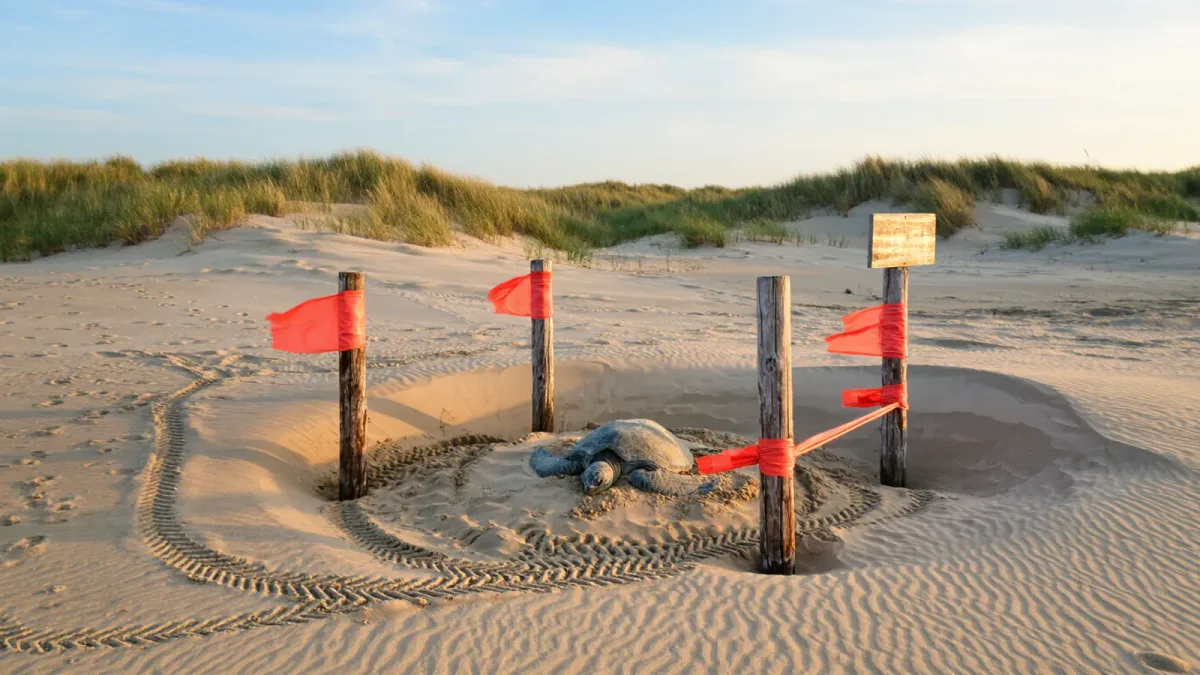
Sea turtle nesting season turns the Southeast's beaches into protected habitat every year from spring through fall: Florida's season runs from March 1 through October 31 across most of the coast, per the Florida Fish and Wildlife Conservation Commission, with Georgia and the Carolinas following from May into September as loggerhead females — the Southeast's dominant nester — crawl ashore at night to lay clutches of roughly a hundred eggs. The rules that follow are not decoration: lighting ordinances go into force in season in most Florida coastal towns, hatchlings emerge mostly at night and navigate by the light of the moon over the ocean, and a single misplaced flashlight or unfilled sandcastle hole can cost a brood. For a traveler, the change is manageable and mostly free — this guide covers the calendar, the do's and don'ts, and what actually happens if you follow them. The managing authorities are state wildlife agencies and, where the beaches are federal, the National Park Service; their posted rules govern each specific beach.
Why the stakes are real: all sea turtles that nest on US beaches are protected under the Endangered Species Act, and the Southeast hosts the majority of the loggerhead nesting in the western hemisphere, per the wildlife agencies that have surveyed it for decades. A beach vacation overlaps the most fragile months of an ancient cycle, which is why the compliance asks below are so specific.
When is nesting season where?
Florida first, because it hosts most of it: nesting begins March 1 on the Atlantic coast and runs through October 31, per FWC, with the bulk of loggerhead nesting in May through August and hatching stretching into the fall. Georgia's nesting runs May through roughly September, with the state's Department of Natural Resources surveying nest counts annually; South Carolina follows the same May-to-fall pattern, managed by its Department of Natural Resources and the volunteer nest teams that cage and monitor clutches. Texas's Gulf beaches host the critically endangered Kemp's ridley, with nesting mostly April through July, watched closely by the federal and state programs at Padre Island National Seashore. The season windows shift a week or two at the edges year to year — the managing agency's current-year page is the authoritative calendar.
What are the actual rules for beachgoers?
The season's code fits on a card. Leave nests alone: a marked nest — usually four stakes and often a sign — is monitored by permitted teams, and disturbing it is a federal offense, not a parking ticket. Keep lights off or shielded on the beach at night: no flashlights, no flash photography, and in most Florida coastal towns, in-season lighting ordinances require beachfront properties to dim or shield their lights, because hatchlings crawl toward the brightest horizon and mistake beachfront glow for the moon over the water. Fill in holes and knock down sandcastles before you leave, since both trap hatchlings and crawling mothers. Take chairs, umbrellas, and toys home each night. And give a nesting female or a hatchling sprint a wide, dark berth — do not touch, do not carry hatchlings to the water, do not photograph with flash. Report anything that looks wrong — an unmarked turtle, disoriented hatchlings — to the local authority; FWC's hotline is the standard channel in Florida.
Where can travelers see turtles legally and well?
Several venues run the public-education version of the season properly. Canaveral National Seashore in Florida offers ranger-guided sunrise and nighttime programs in season, where the National Park Service's permitted staff manage access to an actual nesting beach — the closest thing to a guaranteed, ethical sighting. Archie Carr National Wildlife Refuge, on the Brevard–Indian River county line, protects one of the Western Hemisphere's densest loggerhead nesting beaches, with local education groups running guided walks under permit. Georgia's Jekyll and Cumberland Island beaches run state-park and National Park Service programming respectively. The pattern is consistent everywhere: permitted, guided, small-group, no-flash. Unofficial nighttime beach walks to find turtles are exactly what the rules exist to stop.
What does a beach town actually change in season?
More than visitors expect, mostly invisibly. Streetlights switch to turtle-safe amber spectra in season along some developed beaches; codes enforcement shifts to night light patrols; beachfront properties receive dimming notices; and seasonal rangers and volunteers mark every new nest each morning from a truck or an ATV before the beach opens. Consequences are real on both sides: the lighting ordinances carry fines in most adopting towns, and the hatchling-protection campaigns have measurably worked — nest counts in Florida and Georgia have trended up over recent decades of protection, per the state agencies' survey programs, one of the quiet conservation successes on the US coast. A traveler who books a season-week beachfront stay should read the rental's turtle-lighting instructions as part of the check-in packet; they are house rules with a federal backbone. Conditions and rules change — check the official advisory before you go.