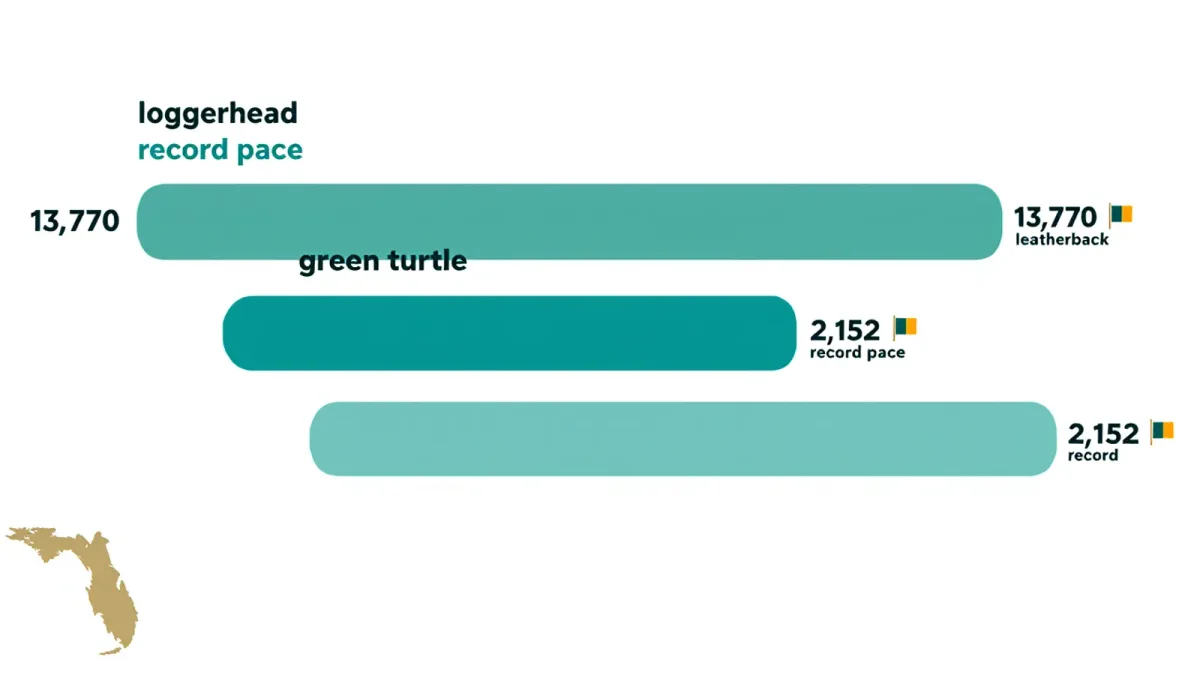
Florida's beaches had logged a record 13,770 loggerhead sea turtle nests by early August 2026 — hundreds of nests beyond the previous record pace, with more than two months of nesting season still to run, per The Guardian's August report on the count. The tally, tracked through the Florida Fish and Wildlife Conservation Commission's survey network, caps a season that has already set records on other species and sets up an unusually busy hatchling summer on the state's most turtle-dense beaches.
This is a wildlife-count news note, not wildlife-handling guidance; lighting rules and nest protections are set by FWC and local beach authorities and apply to everyone on the sand after dark.
What a record loggerhead count means
Loggerheads are Florida's most abundant large nester, and their counts swing with ocean conditions across multi-year cycles — which is why a single season is never a verdict, but a sustained run of strong years is. The 2026 number arrives on the heels of record and near-record seasons for leatherbacks and green turtles, per FWC's season updates, making 2026 the strongest overall nesting year in recent memory by midsummer.
Where the hatchlings will be
The nests counted so far will hatch roughly 45 to 65 days after laying, which puts the heaviest emergence activity in August and September on the beaches where loggerheads concentrate — the Brevard County stretch of the Space Coast, the Barrier Island shorelines of Martin and Palm Beach counties, and the dry, wide Panhandle strands. For a visitor, that shows up as small mesh cages over marked nests by day and, at night, the chance of seeing a boil of hatchlings make their scramble — watched, ideally, on a guided walk with a permitted program.
The traveler's part of the bargain
FWC's standing rules do the work: no flashlights or phone lights on the beach at night, no approaching nesting females or hatchlings, fill holes, remove chairs and tents, and leave the marked nest boxes exactly as they are. Beach towns with record nests also tend to enforce lighting ordinances strictly through October — a modest ask that keeps a phenomenon this large coming back.