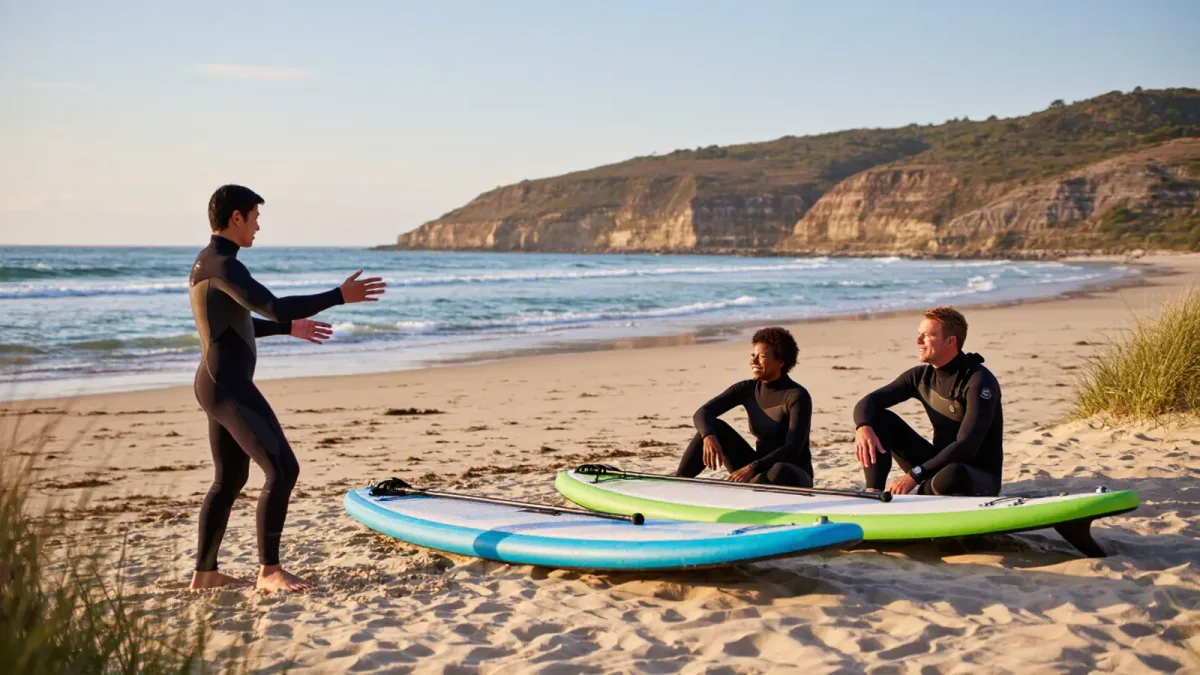
The best beginner surf on the West Coast shares a formula — a protected cove or inside sandbar that slows the wave down, a school that has taught on the same beach for years, and a wetsuit that makes cold water irrelevant — and five places execute it best: Cowell's Beach in Santa Cruz, Tourmaline Surfing Park and La Jolla Shores in San Diego, the beaches around Ventura, California's Malibu coast in its gentlest corners, and the small beach at Pacific City on the Oregon coast. West Coast water runs colder than East Coast summer water at the same latitude — NOAA buoy climatology puts Northern California in the 50s Fahrenheit most of the year — so the wetsuit is not an accessory but the ticket, and every school rents them with the board. This guide works beach by beach from north to south, with the season, the crowd pattern, and the practical details for each; conditions change daily, so the marine forecast and the beach manager's advisory come before any booking.
A note on expectations before the list: the West Coast's iconic point breaks are expert waves, and learning does not happen at Malibu's first point or Santa Cruz's Steamer Lane. It happens at the soft, inside waves those famous breaks shelter — which is precisely why the towns around them built such deep teaching scenes.
Why is Cowell's Beach the Northern California default?
Cowell's Beach, inside Santa Cruz's harbor-side city park, may be the most reliable beginner wave on the Pacific Coast: a long, gradual point-protected cove where swells wrap in slow and break far softer than at Steamer Lane, visible across the water as a reminder of what comes later. Schools have taught there for decades, the wave works on most swells, and the summer south-swell season plus calm morning wind makes June through September the prime window — though winter learners get the cove nearly to themselves. Water runs in the mid-50s to low 60s in summer, and the standard rental is a 4/3 or 5/4 wetsuit with boots optional; first-timers universally report the suit matters more than the board. The city manages the beach with a paid-lot reality on summer weekends, so arrive at opening or take the shuttle; the promenade's rental shops make gear logistics painless.
What makes San Diego the volume leader?
San Diego teaches more first lessons than anywhere on the coast, for structural reasons: warmest reliable water in California — the 60s and low 70s in late summer per NOAA records — a long tourist season, and two purpose-built learning beaches. La Jolla Shores offers a wide, lifeguarded sand beach with gentle summer waves and a marine reserve offshore; Tourmaline Surfing Park, south of Pacific Beach, is practically a beginner preserve, with its own slow inside wave and a local culture calibrated to learners — kooks are the demographic, not the exception. Schools operate under the city's coastal permits, and summer mornings deliver the pattern that repeats across the coast: offshore-tinged dawn calm, then the onshore breeze by late morning. The season stretches May through October, and shoulder months like May and September thin the crowds without cooling the water much.
Where should you learn around Los Angeles?
Two answers. Ventura, an hour up the coast, is the laid-back one: a walkable beach town whose point-protected beaches hold soft summer waves, whose schools run smaller, and whose prices run gentler than LA County's. The second answer is the Malibu area's gentler options — the inside sections at Zuma and the coves below Point Dume that hold learner waves on summer south swells — where county beach rules and summer crowds require early arrivals but reward them with the most photographed learning environments in the sport. Los Angeles proper adds Venice and Santa Monica, where the broad sand and summer waves sustain a large school scene minutes from the city. Everywhere in the county, the same trade applies: convenience and crowds rise together, and a weekday beats a weekend by an hour of parking and a crowd of people.
Can you learn to surf in Oregon and Washington?
Yes, with commitment. The Oregon coast's beginner hub is Pacific City and the coves around Cape Kiwanda, where state parks and a small, serious school scene run lessons through summer; water in the mid-50s requires a hooded 5/4 wetsuit, which rentals provide, and rip-prone beach breaks are why instructors keep groups close in the inside section. Washington's Westport works the same way on the southern coast. The appeal is exactly the effort: cold-water learning scenes are small and friendly, summer crowds are a fraction of California's, and a hooded wetsuit session followed by a tide-pool walk is a distinctly Pacific Northwest beach day. Book ahead anyway — the good schools run small groups and the season is short, roughly June through early September.
How do West Coast lessons differ from anywhere else?
Three things. The wetsuit is universal — even San Diego summer lessons often include one, and Northern lessons always do, so budget the rental as part of the price rather than a surprise. The swell is groundswell-driven, meaning the wave size changes with Pacific storms far away, and a beach can go from flat to overhead between visits — which is why the school's reschedule policy is worth more than its discount code. And the crowd etiquette is older and firmer: one person per wave, no snaking, and the inside learner zones are understood at every beach in this guide. Book the morning slot, take the two-hour lesson, and if the first day's surf is wrong, take the second — the good schools reschedule on the marine forecast, and so should you. Conditions change — check the official advisory before you go.
| Beach | Town | Best months | Typical summer water | Signature setup |
|---|---|---|---|---|
| Cowell's Beach | Santa Cruz, CA | June–Sept (year-round possible) | Mid-50s to low 60s °F | Point-protected cove, slow waves |
| La Jolla Shores | San Diego, CA | May–October | 60s–low 70s °F | Wide lifeguarded sand, gentle summer surf |
| Tourmaline Surfing Park | San Diego, CA | May–October | 60s–low 70s °F | Beginner-preserve culture |
| Ventura beaches | Ventura, CA | June–September | Low 60s °F | Point-protected, small-school scene |
| Pacific City / Cape Kiwanda | Oregon coast | June–early September | Mid-50s °F | Hooded-wetsuit cold-water learning |