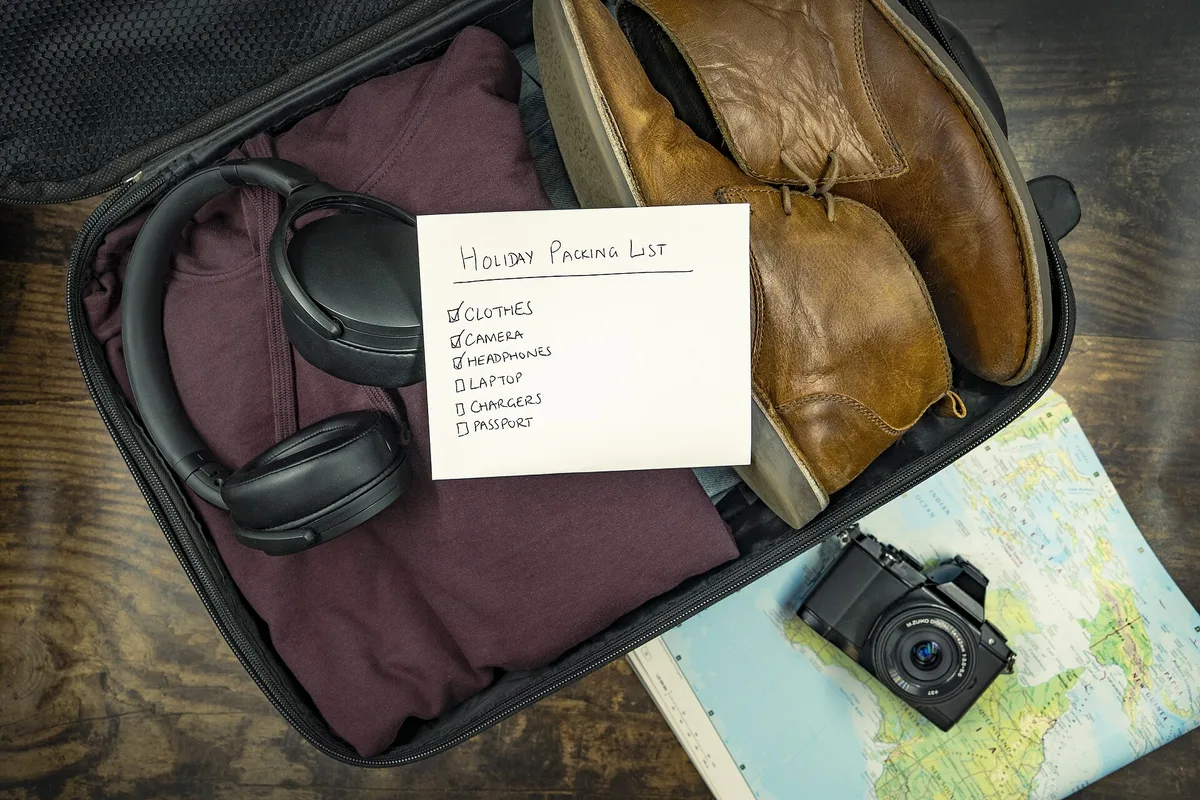
The vacation packing list that works is not the one you find online the night before a trip. It is the one you build yourself, trip by trip, until it covers your actual habits. Frequent travelers do not pack more than everyone else. They pack the same short list every time, refined by what they regretted carrying and what they regretted leaving behind.
The method is simple: one reusable list, organized by category rather than by day, with a short review step after every trip. Build it once and a beach week, a city break, and a two-night work trip all become variations of the same document instead of fresh scrambles.
The word itself carries both meanings. According to the Cambridge Business English Dictionary, packing covers everything from making your suitcases to wrapping goods for shipment, and the Portuguese translations in its entry include both "fazer as malas" and "empacotamento" — the traveler's job and the shipper's job. That overlap is useful. The logistics industry treats packing as a deliberate process: choose the container, verify the contents, protect against damage. Travelers can borrow all three steps.
What does a capsule packing list actually look like?
A capsule list is a fixed set of items that mix and match, sized to the trip. For a week on any US coast, that usually means a small number of tops that all work with the same bottoms, one layer for air conditioning and evening wind, swimwear that dries overnight, and one pair of shoes beyond the pair you wear in transit. Everything on the list has to earn its space twice: once for the beach, once for dinner or the drive home.
The discipline matters more than the item count. Pick a container first — a carry-on, a duffel, a beach tote with a zip top — and let it cap the list. When the container is full, the list is done. Travelers who do it the other way, writing the list first and finding a bag second, almost always overpack.
For a full category-by-category breakdown of what a coastal week requires, our Beach Vacation Packing List covers the twelve categories that handle a week on any US shoreline. Use that as the starting inventory, then cut it down to your own capsule. We covered a connected angle in Beach Vacation Packing List: The 12 Categories That Cover a Week on Any US Coast.
Why do category lists beat day-by-day lists?
Day-by-day lists look organized and fail quietly. They assume you will wear exactly what you planned on the day you planned it, and they multiply items, because every day gets its own outfit. Category lists — tops, bottoms, layers, swim, footwear, toiletries, documents, electronics, beach gear — let you pack to a count instead of a schedule.
Categories also survive plan changes. If the boat trip moves to Thursday, a day-by-day list needs rewriting; a category list does not. And when you unpack at a rental, categories make it obvious within a minute whether anything is missing, because each group has a known count.
A short checklist inside each category helps: documents and IDs, medications, chargers, and one spare of anything that ruins a day if it fails — sunglasses, a swimsuit, a phone cable. Those four groups are where most packing regret lives.
How do you adapt one list for beach, city, and everything between?
Keep a master list with three layers. The core layer never changes: clothes by category, toiletries, documents, electronics. The trip layer swaps in the destination-specific items — for the shore, that is swimwear, a wide-brim hat, reef-safe sunscreen, and a dry bag. The condition layer handles what the forecast and the rental rules add: a rain shell, a light sweater for breezy evenings, or gear you decided to rent rather than carry.
Renting is often the right call at the beach. Umbrellas, bikes, and kayaks are bulky to transport and cheap to rent by the day, and the deposit math usually favors leaving them at home — Renting Beach Gear walks through the rates and booking trade-offs. The same logic applies to city trips: skip the umbrella you might need and buy a cheap one there if the sky turns.
What this means in practice: your master list should have a "rent on site" column, not just a "bring" column. Every item you can source locally is weight and handling you never pay for.
What is the review step that makes the method work?
The method only compounds if the list learns. On the last morning of every trip, do a two-minute audit before you pack for home: what did you never touch, and what did you wish you had? Write both down on the list itself. Over three or four trips, the list converges on what you actually use, which is usually far less than what you first packed.
The ride home has its own physics. Salt, sand, and damp gear need separating from clean clothes, or the whole bag smells like a wetsuit for a week — our guide to packing beach gear home covers the rinse-and-bag routine that keeps the rest of your luggage clean. Build a small "dirty exit" sub-list: a wet bag, a trash bag for sandy shoes, and a separate pocket for anything that got wet. For related coverage, see Packing Beach Gear Home: The Salt, Sand, and Wet-Suit Physics of a Clean Coastal Exit.
The best packing list is not written before a trip. It is rewritten after one.
Practical steps to build your first list this week
- Pick your standard container and treat its size as a hard limit.
- List by category, not by day, with a count next to each category.
- Add the three layers: core, trip-specific, and condition-specific.
- Mark anything bulky or rentable as "rent on site" instead of "bring."
- After each trip, strike what you never used and add what you missed.
Store the list where you actually plan — a note app, a spreadsheet, the back of a passport folder. A list in a drawer helps no one at eleven the night before an early flight.
The takeaway: a list is a system, not a document
The evidence here is mostly about method, not measurement: no study says a capsule list saves a specific number of minutes, and anyone promising one is guessing. What the approach reliably does is cut decisions. With a maintained list, packing becomes verification — check the counts, add the trip layer, close the bag. What remains unknown is your own usage pattern, and only your last few trips can tell you that. Start with a borrowed structure, then let the review step make it yours.