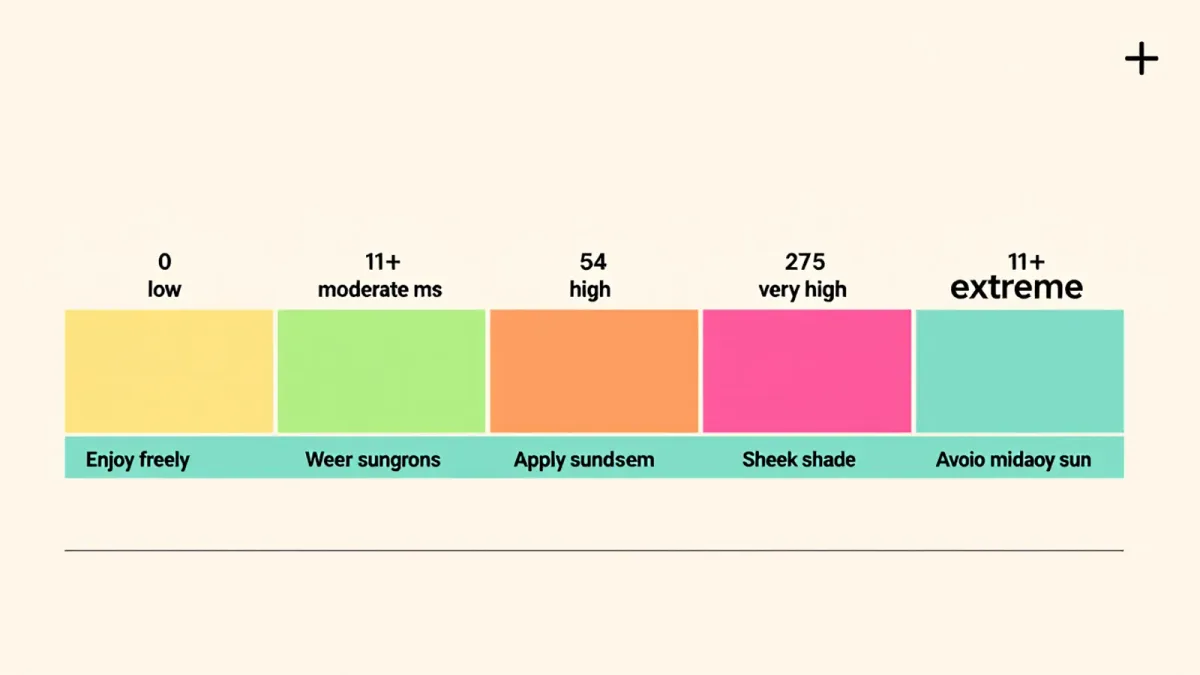
The UV Index is the beach day's most useful number: a 0-to-11-plus scale, issued daily by the National Weather Service and EPA in the SunWise program framework, where 0-2 means minimal protection needed, 3-7 calls for the standard protections, and 8-plus means unprotected skin can burn in minutes. At US beaches, summer UV Index values routinely run 8-11 on the Gulf and Atlantic coasts and 10-plus at midday in southern California, per NWS forecast products. The sunscreen math that matches it: broad-spectrum, water-resistant SPF 30 or higher, one ounce per adult body, reapplied every two hours and after swimming, per the American Academy of Dermatology's published guidance.
What does the UV Index number actually measure?
The UV Index translates forecast ultraviolet radiation into a single daily danger number. Per the EPA and NWS, it weighs UVA and UVB together with the midday maximum — the scale reflects the day's peak, not the average — and it rises with sun angle, altitude, ozone conditions, and cloud cover's limits (clouds filter some UV but far from all; a bright overcast can still deliver a burn). The practical readings: 0-2, low, protection minimal; 3-5, moderate, shade at midday and sunscreen; 6-7, high, the full protocol; 8-10, very high, burn times shorten sharply; 11-plus, extreme, midday exposure is unwise for anyone, per the EPA's UV Index guidance.
Why beaches raise the stakes: reflection, shade, and wind
The beach multiplies UV in three ways. First, reflection: sand reflects roughly 15-25 percent of UV back up at you, and water adds more, per EPA UV guidance — meaning shade structures and hats under-perform what people assume, because the dose arrives from below as well. Second, the shade deficit: unless the source is a roof, beach shade — umbrellas, canopies — blocks direct UV only, so the reflected component remains; studies cited by the EPA and dermatology organizations show meaningful UV exposure under beach umbrellas alone. Third, wind and water strip sunscreen, sweat cues, and heat warnings faster, so the reapplication clock is the one control that survives all three.
SPF: what the number promises and what it does not
SPF measures protection against UVB — the burn spectrum — as a time multiplier under test conditions: SPF 30 theoretically allows 30 times longer exposure before burning, per AAD explanations, but the test conditions do not survive a swim, a towel, or an hour of sweat. Two facts carry the practical weight: no sunscreen blocks 100 percent (SPF 30 filters about 97 percent of UVB, SPF 50 about 98 percent, per AAD), and under-application erases the label — applying a quarter of the tested dose cuts protection far more than the difference between SPF 30 and 50. Broad-spectrum matters because UVA, the aging and deeper-damage spectrum, is not captured by SPF alone; the label term is the only marker that it is.
How much sunscreen and how often — the real math
The AAD's application guidance is specific enough to plan around: one ounce — a shot glass — covers an adult's body, applied 15 minutes before exposure, reapplied every two hours, and after every swim or heavy sweat, even on water-resistant formulas, which are tested to remain effective for either 40 or 80 minutes in water, per the AAD and FDA labeling rules. For a family of four on a full beach day, that is roughly four ounces across the day — a full tube — and most people apply a quarter to half of the tested dose, per AAD consumer guidance. Pack accordingly: the travel-size tube is a two-day product, not a week's.
Reading the UV forecast for your beach day
The index is a forecast product, and the NWS publishes it daily in zone forecasts and via the EPA's UV Index tool, searchable by ZIP code, per both agencies. The planning habit: check the index the evening before, and plan the day around its peak — solar UV runs strongest roughly 10 a.m. to 4 p.m., per the EPA. The beach version of this is not hiding indoors: it is sequencing — water time and long walks early and late, shaded setup and lunch at the peak, and the full protocol whenever the index reads 6 or above. At 8-plus, the midday beach hour belongs under a canopy with long sleeves on children, per the same guidance.
Babies, kids, and the groups that need the strict version
The AAD and American Academy of Pediatrics guidance converges on the strict rules: infants under six months stay out of direct sun, shaded and covered, with sunscreen used only on small exposed areas when shade and clothing cannot cover the exposure, per AAP guidance. Children run the full protocol with extra margin — rash guards, hats, and the two-hour reapplication enforced by an adult, because the burn dose accumulates faster in kids' skin and childhood burns are the exposure history that matters most, per dermatology consensus. Adults on photosensitizing medications — a long common list, including some antibiotics and acne treatments — should check their medication's label and plan the strict version, per FDA labeling and clinician guidance.
What actually protects you at the beach — the ranked list
Dermatology guidance ranks protections by reliability, and sunscreen is not first. Shade structures and timing are first; clothing second — a tightly woven rash guard delivers an SPF its fabric label states, without reapplication failure; hats with brims that shade face, ears, and neck third; UV-rated sunglasses fourth, protecting the eyes' exposed surfaces; sunscreen fifth but essential for what clothing and shade cannot cover, per the AAD's prevention guidance. The beach translation: book the umbrella and pack the rash guard, then let sunscreen cover the gap. That stack — not any single product — is what the UV Index 9 day demands.