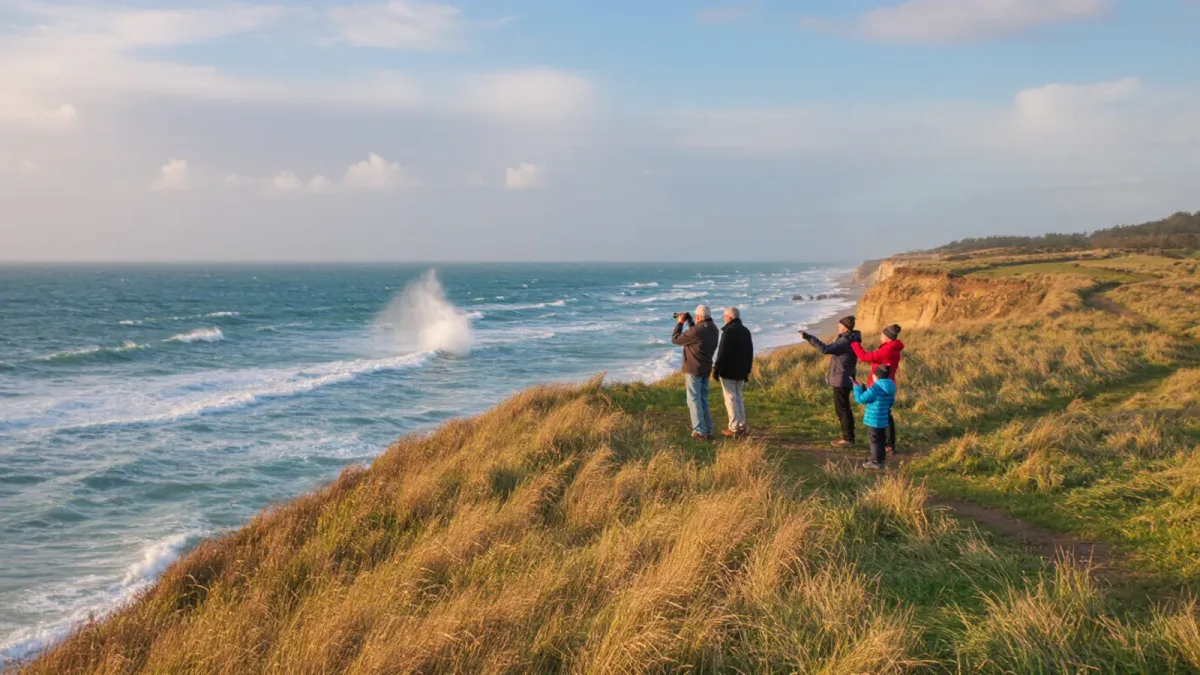
Right now, along the entire West Coast, the gray whale migration is running its winter leg: southbound whales that left Arctic feeding grounds are passing California and the Pacific Northwest on a roughly 10,000-mile round-trip trip to the protected lagoons of Baja California, where calves are born in winter. NOAA Fisheries, which manages the species under the Marine Mammal Protection Act, tracks the eastern North Pacific population's cycle, and the travel-relevant facts are fixed by decades of observation: the southbound passage peaks along the US coast between late December and January, and the northbound return — the one to plan a second trip around — moves mothers with calves close to shore in March, April, and May. You do not need a boat: gray whales migrate within sight of coastal headlands, and organized shore-based watch programs put volunteers on the headlands at the peaks each season. This explainer covers the calendar, the best shore-based sites, and the ethics and practicalities of watching.
The population's recent history shapes expectations. After an unusual mortality event that NOAA Fisheries tracked from 2019 through 2023 — strandings elevated, the population visibly reduced — the agency's scientists have documented signs of stabilization in recent surveys. The practical translation for a winter visitor: whales are present in normal numbers for the current population, but on any given watch day the honest expectation is spouts and flukes at distance, not breaching shows.
When exactly should you plan a winter whale-watching trip?
The southbound migration is staggered by cohort: adult whales without calves pass first, the peak along Central California falls in the first three weeks of January, and the stragglers trail into February. Timing varies with the whales' Arctic summer, and individual whales travel on their own schedule, so the honest planning rule is a two-week window rather than a date. Weather matters as much as whales: gray whales show as spouts against flat, bright water, and a gale or thick fog erases the view entirely. The classic formula is a morning visit after a front clears — post-storm clearance days are the ones watch programs report as their best. Oregon State Parks runs its Whale Watch Spoken Here program around the winter peak each year, staffing coastal viewpoints with trained volunteers, and its published watch weeks are the easiest public indicator of when the southbound animals are moving past that state.
Where are the best shore-based viewpoints?
Elevation over open water is the whole game: headlands and bluffs that look down on the corridor see far more than beaches at sea level. The reference sites run the coast — Point Reyes Lighthouse and the Sonoma and Mendocino headlands in Northern California; the points around Monterey and Big Sur; Point Vicente in Los Angeles County, where a long-running count project logs season totals; and San Diego's Cabrillo National Monument at the corridor's southern edge. In Oregon, the central coast's Depoe Bay and Cape Perpetua anchor the volunteer watch program's network. In Washington, the Salish Sea adds a second act — the same population's members feed in spring and summer along the inland waters of Puget Sound, a phenomenon documented closely enough that NOAA Fisheries maintains a separate research effort on the so-called Sounders group. Pick one headland, plan two hours, bring layered clothing and binoculars.
What does a whale actually look like from shore?
Manage the preview: a gray whale from a headland is usually a bushy, heart-shaped spout hanging in the air for a few seconds, then a long dark back, then — on a good pass — the fluke raised as the animal dives on a feeding or travel interval of three to six minutes. Afternoon backlight kills the effect; a morning sun behind you puts the spouts in relief. Scanning matters more than staring: sweep the water from near to far with binoculars, and watch for boat traffic — whale-watching vessels converge on animals faster than most visitors can find them, and the boats mark the whales for you. Counts from the shore-based projects, posted seasonally, confirm what watchers learn quickly: the southbound stream is broad but thin, a matter of steady animals per hour at peak rather than herds.
What about boat tours and Baja's lagoons?
Commercial whale-watching boats run the season from San Diego to Seattle, and the operators who follow the watching guidelines keep predictable distances; booking the morning trip maximizes both calm seas and whale activity. The winter destination trip, though, is Baja California Sur: in the breeding lagoons — Magdalena Bay, San Ignacio, and others — whales gather in concentrations the open coast never shows, and permitted local operators run pangas into the lagoons in the January-to-April window under Mexican wildlife authority rules. That is a separate trip with separate permits and operators, and it is the one context where close, authorized encounters are part of the design. For the US coast, the rule is the National Oceanic and Atmospheric Administration's viewing guidelines — 100 yards is the standard stay-back distance for large whales, and drones are prohibited.
What comes next on the calendar?
The northbound migration, March through May, is the underrated season: whales travel closer to shore on the return, mothers with calves come last and pass nearest the beach line — sometimes in the surf zone itself — and the spring watch weeks pick up where the winter ones end. Oregon's program runs its spring watch week around the late-March peak, and the Southern California counts run the entire northbound season with posted daily numbers. The season's full arc, in other words, spans about five months from first southbound scouts in December to the last mothers and calves in May — a long, forgiving window by migration standards, and one of the few wildlife spectacles on this coast that rewards the patient landlubber as much as the boat passenger. Conditions change — check the official advisory before you go.