The easiest way to start birdwatching is not in a forest at dawn. It is on a beach, mid-morning, with a coffee still warm in your hand. Shorebirds feed in the open, in plain light, and they move slowly enough for a beginner to actually study them. No hidden canopy, no five-second flits between leaves.
There is a small ritual to it, too. You walk the wet sand line where the last wave slid back, and the birds part around you like water and close again behind. Sanderlings are the ones doing the running — chasing the foam out, fleeing it back, all day, without seeming to tire. Learn that one behavior and you have already learned to identify a bird by what it does, not just how it looks. We covered a connected angle in Where to Learn to Surf on the West Coast: Five Beginner Beaches With Real Schools.
This guide covers what to look for, when the shore is at its liveliest, and what gear actually earns its place in your beach bag. If you want the calendar side in more depth — where migration peaks fall on different US coasts — our Coastal Birdwatching Calendar: Where and When Migration Peaks on US Shores lays it out region by region.
Why the beach is the best classroom for birdwatching for beginners
Most birdwatching fails for beginners for one reason: the bird is gone before you get a look. Beach birds solve that. They stand in the open, they feed in predictable places, and they repeat the same behaviors over and over, which gives you time to notice shape, bill length, and leg color — the three field marks that do most of the identifying work.
Bill length is the trick worth learning first. On a crowded sand flat you will often see several small gray-brown birds side by side that look nearly identical at a glance. The bills sort them. A short stubby bill belongs to a bird that pecks at the surface; a long, curved or needle-thin bill belongs to a bird that probes deep into the wet sand for worms and crabs. Once you start sorting by bill, the flat stops being a mob of brown birds and becomes a set of distinct species doing distinct jobs.
Behavior helps even more. Some birds chase waves. Some sleep in tight flocks with their heads tucked. Some run in short bursts and stop dead. Watch what a bird does with its time and you can often name it before you raise the binoculars.
What to look for: the beginner's three field marks
Keep it simple. Three things will carry you a long way:
- Size against a known bird. Is it robin-sized, gull-sized, goose-sized? Comparing to a bird everyone knows is faster than guessing measurements.
- Bill shape and length. As above — this is the single most useful mark on shorebirds, because so many of them wear the same gray-brown plumage.
- Legs and behavior. Leg color separates look-alikes that bills miss, and feeding style — runner, prober, dabbler, diver — confirms it.
Resist the urge to name everything on day one. A good first goal is humbler: learn to tell gulls from terns, then sandpipers from plovers. Terns fly with the bill angled down and hover before diving; gulls mostly float and scavenge. Plovers are the stop-and-start runners with short bills; sandpipers probe. Those two distinctions will make your first month on the sand feel like progress.
When to go: migration timing without the guesswork
Two windows matter on most US coasts. In spring, shorebirds move north in a concentrated push, often stopping on the same beaches and mudflats for days at a time to refuel. In late summer and fall, the southbound movement is longer and more spread out, and it includes young birds still in fresh plumage — which can be confusing, but also means more birds and more variety over more weeks.
The honest answer on exact timing is that it shifts by region and by year, and it is worth checking rather than assuming. Local Audubon chapters and refuge staff post what is moving through their own stretches of coast, and a refuge visitor center will usually tell you which impoundment or beach flat is hot this week. Our Seasons coverage follows the coastal calendar through the year, and the migration calendar piece linked above gives the regional picture.
Tides matter as much as season. Rising and falling water exposes the mudflats and sand bars where birds feed, so the hour or two around low tide is generally when the flats are busiest. Plan your walk around the tide table for your specific beach rather than around the clock.
The binoculars worth buying — and the ones to skip
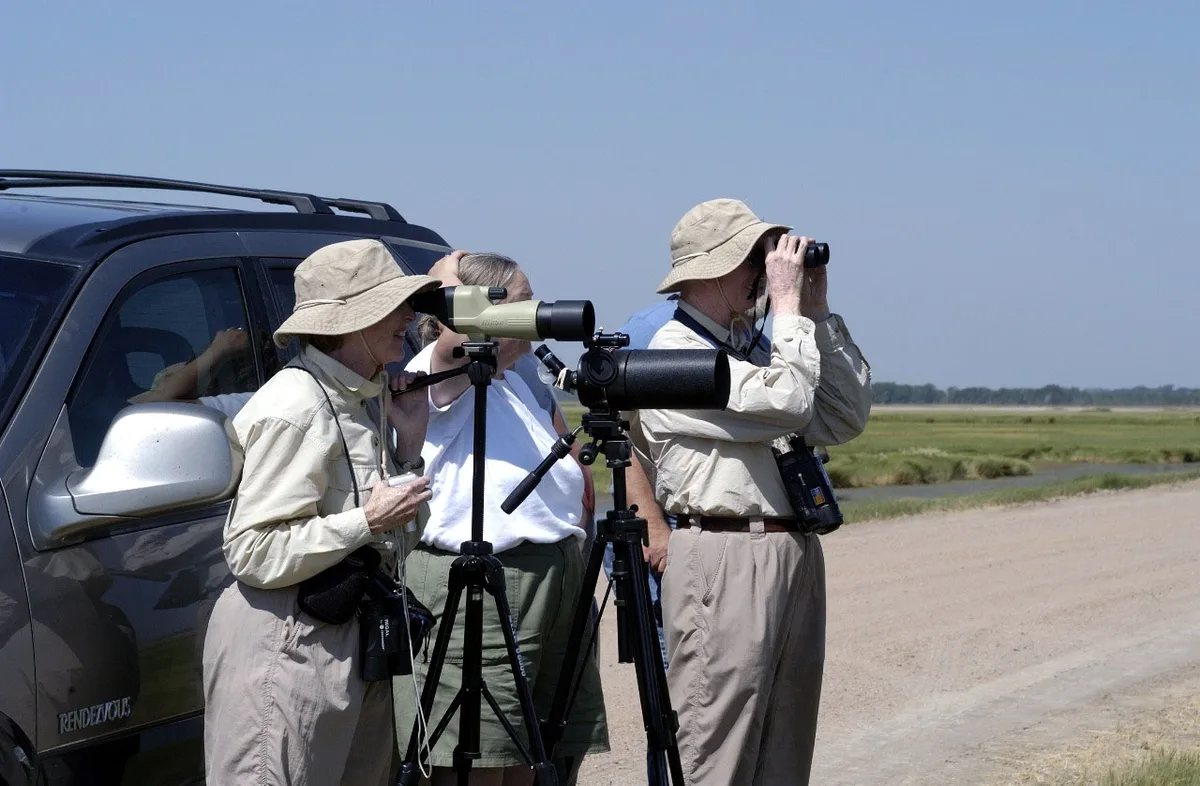
Here is the good news: you do not need expensive optics to enjoy beach birding. Bright, open light and distant, slow-moving subjects are forgiving. What matters is that the image is sharp enough and bright enough that you enjoy looking through the binoculars rather than fighting them.
- Start with a standard magnification, not a big zoom. A mid-range magnification with a moderate objective lens gives a wider, steadier, brighter view than a high-magnification compact. High zoom sounds appealing and mostly delivers shake.
- Weight matters more than specs. A pair you leave in the car because it is heavy is worse than a modest pair that lives in your beach bag. Hold several before buying if you can.
- Waterproofing is worth it at the shore. Salt spray, sand, and humid beach bags are hard on optics. Sealed, waterproof models are the sensible default for coastal use.
- Skip the cheapest compacts. Tiny pocket binoculars at the very bottom of the price range tend to have dim, blurry views that discourage exactly the beginners who bought them.
If you can, try before you buy — nature centers, refuge gift shops, and local birding groups often have demo pairs, and members are usually happy to let a newcomer look through theirs. A neck strap that actually distributes weight is the most underrated accessory in the hobby.
Beach etiquette: how to watch without disturbing the birds
This is the part that separates a birder from a bystander. Shorebirds burn enormous energy on migration, and every time a flock flushes into the air, they burn more of it. A few habits keep your presence cheap for them:
- Walk around feeding flocks rather than through them, even if it means wet feet.
- Give posted nesting areas — fenced or roped sections of beach in spring and summer — a wide berth; those closures exist because birds nest directly on open sand.
- Keep dogs leashed or leave them home where local rules restrict them on bird beaches.
- If a bird stops feeding and stares at you, you are too close. Back up a few steps and it will usually resume.
Many coastal beaches share space with protected nesting and roosting sites managed by wildlife agencies, and the closures change season to season — one more reason to check the managing authority's page for your specific beach before you go.
What this means for your first trip
Our analysis of what actually gets beginners hooked is simple: go where the birds are easy, at the hour they are busiest, with gear light enough to carry. Pick a beach with a mudflat or an estuary nearby — sheltered water holds more shorebirds than a bare surf beach, and our piece on coastal estuaries where kayaking and paddleboarding beat the open beach covers several such spots. Bring binoculars, a tide table, and no expectations of naming everything. For related coverage, see Five Coastal Estuaries Where Kayaking and Paddleboarding Beat the Open Beach.
It is a low-stakes way to begin, which is part of the point. Merriam-Webster's dictionary traces "start" back through Middle English to words meaning a sudden spring or movement — which is, fittingly, exactly what a shorebird does when the foam reaches its feet. You start the same way: one small, sudden move onto the wet sand, binoculars up, and the beach turns from scenery into something worth reading.
Conditions change — tides, closures, and advisory postings differ by beach and season — so check the managing authority's current information before you go, and keep your first outings short. The birds will still be there next weekend.